Introduction: How Lenskart Changed the Eyewear Business in India
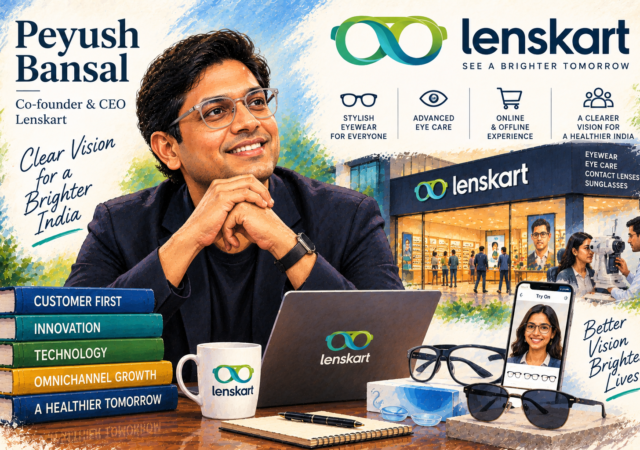
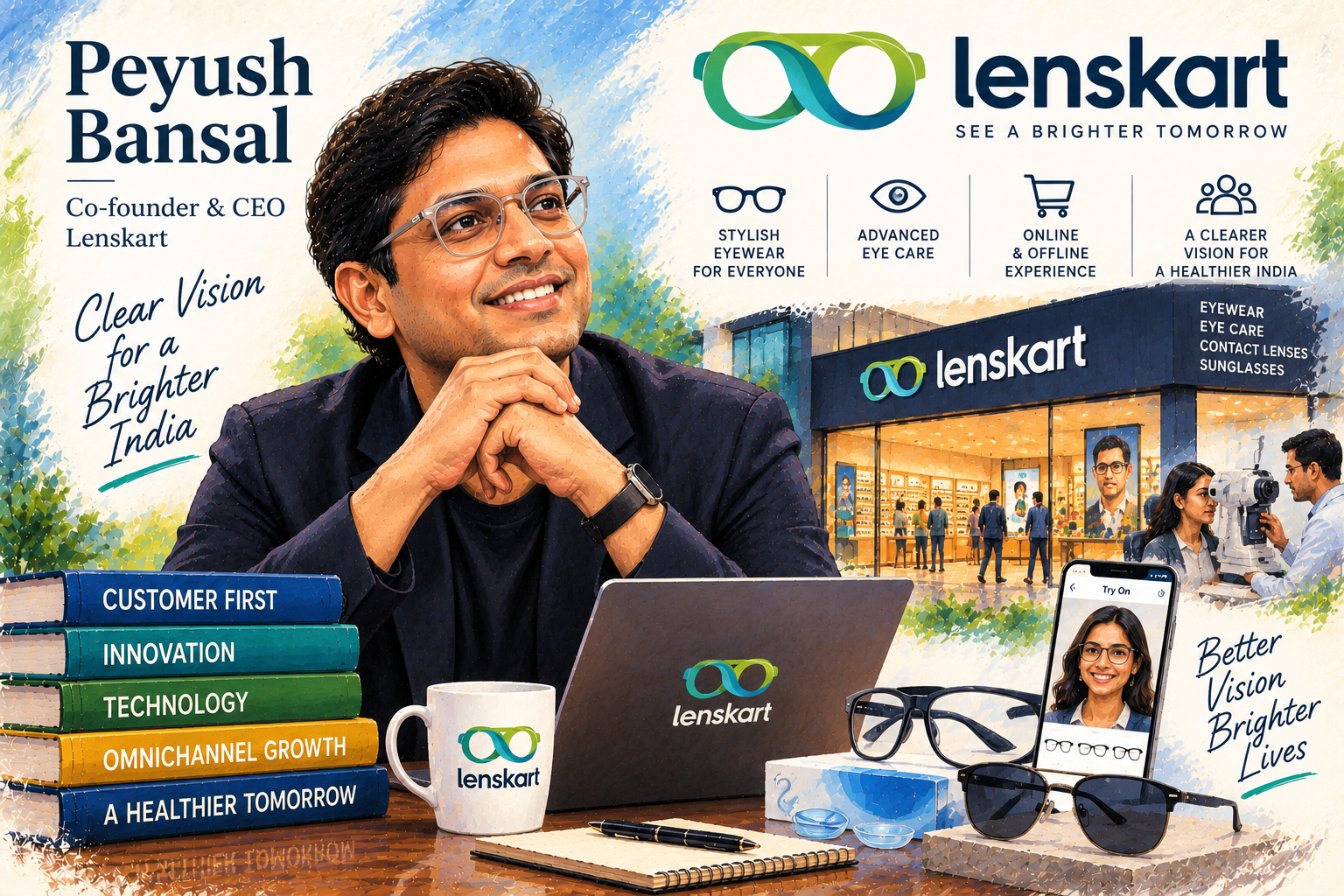
Peyush Bansal is one of India’s most recognisable entrepreneurs, best known as the co-founder and CEO of Lenskart and as an investor on Shark Tank India. His entrepreneurial journey demonstrates how a traditional retail category can be transformed by combining technology, product design, manufacturing capabilities and customer-focused distribution.
Before Lenskart became a familiar name, buying spectacles in India often involved visiting a neighbourhood optician, choosing from the frames available in the shop and relying on local services for prescription lenses. Customers had limited opportunities to compare designs, and fashionable eyewear could be expensive. The purchasing experience was largely dependent on the quality and selection offered by individual retailers.
Lenskart identified an opportunity to make eyewear more accessible, affordable and convenient. Rather than relying exclusively on physical stores or selling spectacles through an online catalogue, the company developed a business model combining digital discovery, physical retail outlets, eye-testing services and technology-enabled manufacturing.
This approach helped Lenskart evolve from an online eyewear business into a large omnichannel retail company. Its story is particularly valuable for entrepreneurs because it shows how businesses can use technology to improve an existing industry rather than necessarily inventing an entirely new product category.
Who Is Peyush Bansal?
Peyush Bansal is an Indian entrepreneur who studied electrical engineering at McGill University in Canada and subsequently worked at Microsoft in the United States. His early professional experience exposed him to technology and large-scale business operations. However, he eventually decided to pursue entrepreneurship rather than continue on a conventional corporate career path.
Bansal returned to India with an interest in building businesses that used technology to solve practical consumer problems. His early entrepreneurial activities included online businesses and e-commerce initiatives. These experiences helped him understand the opportunities and challenges associated with selling products over the internet.
One important insight emerged from his work with online retail businesses: a company did not necessarily need to compete across every product category. By concentrating on a specific market and understanding it deeply, a startup could build expertise, establish a distinctive position and develop a scalable business.
Eyewear presented an interesting opportunity because it combined a functional requirement with personal style. Customers needed spectacles for vision correction, but they also wanted frames that suited their appearance, lifestyle and budget.
Bansal subsequently built Lenskart with co-founders Neha Bansal, Amit Chaudhary and Sumeet Kapahi. Their complementary contributions helped the company develop its product range, sourcing capabilities, retail operations and technology platform. The business was incorporated in 2008 under the name Valyoo Technologies and began its Indian online operations in 2010. Its first physical retail store opened in New Delhi in 2013, according to Lenskart’s official corporate history.
The Business Opportunity Behind Lenskart
The eyewear market offered several challenges that a technology-led company could attempt to solve. Traditional optical retailers often operated with limited inventory and depended on physical interactions to help customers select frames and obtain prescription lenses. Customers might need to visit multiple shops to find the design, price and service they wanted.
Online retail offered a way to display a much wider selection of products. Customers could browse different frame designs, compare prices and explore options without travelling between shops. However, selling eyewear online introduced its own difficulty: people often want to see how frames look on their faces and understand whether the product fits comfortably.
Lenskart’s opportunity lay in addressing both sides of this problem. It could use digital channels to provide choice and convenience while developing services that helped customers overcome the limitations of online shopping.
The company also recognised the importance of affordability. Eyewear is a recurring consumer need, but customers differ significantly in how much they can spend. A business offering a broad selection across price points could serve a larger market than one focused exclusively on premium products.
This combination of access, choice, technology and affordability became central to Lenskart’s proposition. Rather than treating spectacles as a purely medical product, the company positioned eyewear as both a functional necessity and a fashion accessory.
Understanding Lenskart’s Business Model
Lenskart operates through a combination of product sales, digital commerce, physical retail and technology-enabled services. Its product range includes prescription eyeglasses, sunglasses, contact lenses and related accessories. The company offers products under its own brands as well as selected third-party brands.
The business generates revenue by selling eyewear through its websites, mobile applications, retail stores and other distribution channels. This allows it to serve customers who prefer browsing online and those who want assistance in person.
A major element of the business model is its focus on product development, sourcing and manufacturing. By investing in these capabilities, the company aims to exercise greater control over product availability, quality and costs. The extent of that control varies by product and sourcing arrangement, but the broader strategy is to build an integrated eyewear business rather than operate only as an online marketplace.
The company also benefits from having a direct relationship with customers. Digital channels can provide information about browsing behaviour, popular designs, purchasing preferences and customer feedback. This information can help guide decisions about inventory, product launches and marketing.
However, selling eyewear is operationally more complicated than selling many standard consumer products. Prescription lenses must meet individual requirements, frames need to fit comfortably, and customers may require adjustments or support after purchase. The company must therefore coordinate technology, inventory, manufacturing, retail staff and customer service.
Lenskart’s business model demonstrates that a successful retail platform needs to manage the entire customer journey, from product discovery to fulfilment and after-sales support.
Why Lenskart Combined Online Sales with Physical Stores
One of Lenskart’s most important strategic decisions was to expand beyond online retail and establish physical stores. At first glance, opening stores might seem inconsistent with the goal of building an internet-based business. In reality, the two channels address different parts of the customer experience.
Online platforms offer convenience, a broad catalogue and the ability to compare products from home. Physical stores provide an opportunity to try frames, assess fit, receive assistance and access relevant optical services. For many customers, these experiences complement rather than replace each other.
Lenskart’s first store opened in New Delhi in 2013, three years after its online operations began. This marked the beginning of a broader omnichannel strategy in which digital and physical channels could work together.
A customer might discover a frame online, visit a store to try it on and complete the purchase through a digital channel. Another customer might visit a store for an eye test and later use the app to browse additional designs. The objective is to make the purchasing process convenient regardless of where it begins.
This model also creates opportunities to build customer confidence. Eyewear is a product people wear for long periods, and fit, comfort and appearance can be difficult to assess entirely through a screen.
For entrepreneurs, Lenskart’s experience offers a useful lesson: digital transformation does not always mean eliminating physical infrastructure. Sometimes the strongest business model combines the efficiency of online channels with the reassurance and service of offline interactions.
Technology and Manufacturing as Competitive Advantages
Lenskart’s strategy extends beyond online sales and store expansion. The company has invested in technology-enabled manufacturing and supply-chain capabilities to improve product quality and operational efficiency.
Prescription eyewear requires precision. Lenses must be manufactured according to the customer’s prescription and prepared to fit the selected frame. Errors can lead to customer dissatisfaction, rework and additional costs.
Automation and specialised equipment can improve consistency in lens processing and assembly. Technology can also help businesses manage orders, monitor inventory and coordinate fulfilment across a large retail network.
Lenskart’s official company information highlights its use of robotic techniques in lens manufacturing and its focus on quality control. Its broader approach combines technology with human expertise, including customer support and optical services. These investments are intended to improve reliability while allowing the company to serve a larger customer base.
The strategic significance is that technology can create value in the less visible parts of a business. Customers may notice the frame design and price, but the company’s manufacturing systems, sourcing capabilities and inventory processes can determine whether it can deliver the product efficiently and consistently.
Entrepreneurs should therefore look beyond customer-facing applications when evaluating technology investments. Operational technology can be just as important as a website or mobile app, particularly in businesses where product quality and fulfilment are central to customer satisfaction.
Marketing, Brand Positioning and Customer Acquisition
Lenskart has built its brand around making eyewear accessible while treating it as an expression of personal style. Its products are positioned for different customer segments, from everyday prescription glasses to fashionable frames and sunglasses.
This positioning helps the company appeal to a broad audience. Some customers prioritise affordability and durability, while others care more about design, colour, brand or fashion trends. Offering a range of products allows the business to address these preferences without relying entirely on a single customer segment.
Digital marketing has supported the company’s customer acquisition strategy. Online advertising, promotional campaigns, product discovery and e-commerce visibility can bring potential buyers to the platform. Physical stores then provide another opportunity to engage customers and encourage purchases.
Brand visibility can also create repeat business. Customers who have a positive experience buying spectacles may return when they need a new prescription, want another frame or wish to purchase sunglasses. In a category with recurring needs, customer retention can become an important source of growth.
However, marketing alone cannot sustain a retail business. Promotions may generate traffic, but profitability depends on the relationship between selling prices, product costs, advertising expenditure, store expenses and customer lifetime value.
The broader lesson is that a strong retail brand must connect its promise with the actual customer experience. Attractive advertising can generate the first purchase, but product quality, service and convenience determine whether customers return.
Expanding Beyond India
Lenskart’s growth strategy has extended beyond its original Indian market. The company has entered selected international markets, including Japan, Southeast Asia and the Middle East, according to its official corporate profile.
International expansion creates opportunities to reach new customers and diversify revenue sources. It can also help a company develop capabilities that strengthen its operations in its home market. For example, experience in different retail environments can reveal new approaches to merchandising, customer service and store design.
However, expanding internationally introduces challenges. Customer preferences, purchasing power, regulations, competition and retail economics vary across countries. A product range that performs well in India may require adaptation for another market.
The company must also build local operating capabilities, establish suitable supply chains and ensure that its brand resonates with customers who may be unfamiliar with it.
For entrepreneurs, Lenskart’s international journey illustrates the importance of balancing ambition with local market understanding. A successful business model can provide a foundation for expansion, but it must be adapted to the needs and expectations of each market.
Lenskart’s IPO and the Importance of Financial Discipline
Lenskart’s evolution from an online startup into a large retail business required substantial investment in technology, inventory, manufacturing, stores and customer acquisition. As the company matured, its financial performance and ability to sustain growth became increasingly important.
In 2025, Lenskart moved forward with its public listing process. Its prospectus was filed with the Securities and Exchange Board of India in December 2025, marking a significant milestone in the company’s development. Investors can consult the SEBI filing and the company’s investor-relations portal for official disclosures.
A public listing subjects a company to greater scrutiny of its financial performance, governance, risks and growth strategy. Investors assess whether revenue growth is supported by sustainable margins and cash generation, rather than simply an increasing number of stores or customers.
For an omnichannel retailer, the financial questions are particularly important. Physical stores require rent, staff, inventory and ongoing operating expenses. Digital channels involve technology, fulfilment and marketing costs. Manufacturing and sourcing investments must also generate adequate returns.
Lenskart’s challenge is to balance continued expansion with operational efficiency and customer satisfaction. The ability to open stores and enter new markets matters, but the long-term value of these investments depends on whether they contribute to a sustainable business.
What Entrepreneurs Can Learn from Peyush Bansal and Lenskart
The first lesson is to identify an underserved customer need. Lenskart recognised that eyewear shoppers wanted greater choice, affordable products and a more convenient buying experience. Entrepreneurs can apply the same approach by studying the frustrations customers experience with existing products and services.
The second lesson is to build a business model around the full customer journey. Lenskart did not stop at creating an online catalogue. It expanded into stores, optical services and manufacturing capabilities to address problems that digital browsing alone could not solve.
The third lesson is to use technology where it creates measurable value. Automated manufacturing, digital distribution and better inventory management can improve efficiency and consistency. Technology investments should be linked to specific business outcomes rather than adopted simply because they appear innovative.
The fourth lesson is to build a brand that serves different customer needs. Lenskart’s combination of affordability, design and product variety allows it to appeal to people with different budgets and preferences. Businesses can benefit from clear positioning without assuming that all customers value exactly the same things.
The fifth lesson is to expand in a disciplined manner. New stores, product categories and international markets can create growth opportunities, but each also introduces costs and complexity. Entrepreneurs should evaluate customer demand, operating requirements and unit economics before scaling aggressively.
Finally, the Lenskart story demonstrates that business success depends on execution. A compelling idea may open the door, but sustained growth requires reliable products, capable teams, financial discipline and continuous attention to customer experience.
Conclusion: Building an Eyewear Business Around Customer Needs
Peyush Bansal and the Lenskart founding team built a business that challenged traditional approaches to eyewear retail in India. By combining online shopping, physical stores, technology-enabled operations and a focus on affordability, the company created a model designed around the way customers actually discover, select and purchase spectacles.
Its journey shows that innovation is not always about inventing a completely new product. It can involve redesigning how an existing product is sourced, marketed, sold and delivered.
For aspiring entrepreneurs, the central lesson is to understand the customer problem deeply and build a business model that solves it consistently. Technology, branding and expansion can accelerate growth, but they must work together with sound operations and financial discipline.
Lenskart’s experience is a reminder that building a durable company requires more than attracting attention. The real challenge is to turn customer trust into repeat business and convert growth into long-term value.