Introduction: The Man Behind One of India’s Biggest Business Empires
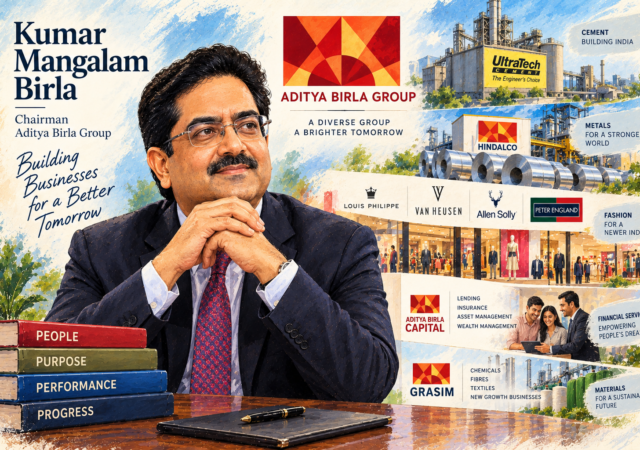
When consumers purchase cement to build a house, shop for branded clothing, use financial services or buy everyday products, they may not realise that many businesses across these industries belong to the same corporate group. The Aditya Birla Group has built a presence across a wide range of sectors, from metals and cement to fashion, chemicals, financial services and telecommunications.
At the centre of this diversified business empire is Kumar Mangalam Birla, the chairman who took charge of the group in 1995 following the death of his father, Aditya Vikram Birla. At the time, he was just 28 years old. Over the following decades, he led the group through expansion, acquisitions, international growth and significant changes in India’s business environment.
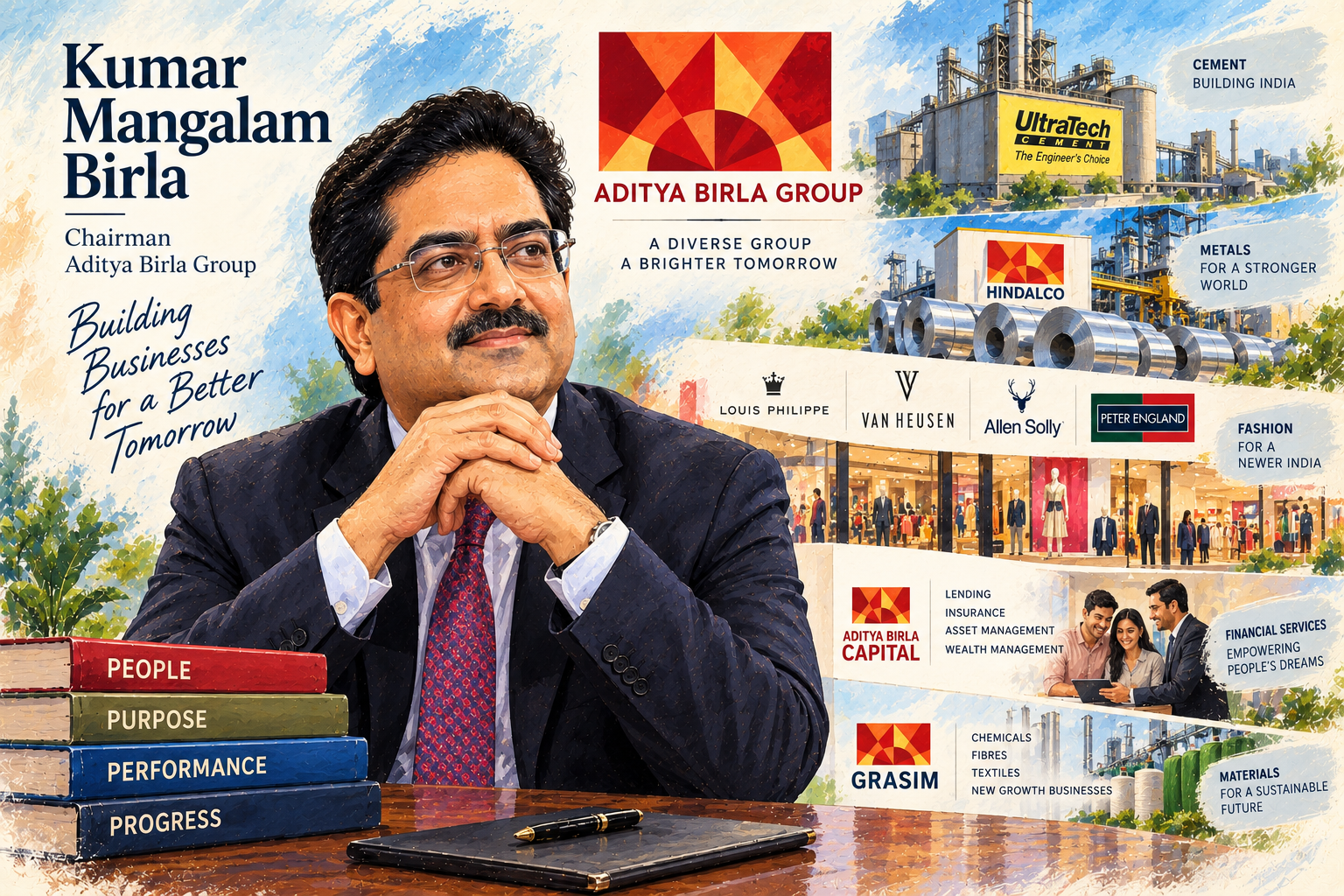
Today, the Aditya Birla Group describes itself as a global conglomerate operating in 41 countries across six continents, with annual turnover of approximately US$67 billion. Its businesses include major companies such as UltraTech Cement, Hindalco Industries, Grasim Industries and Aditya Birla Capital, alongside consumer-facing brands in fashion, jewellery and paints. <Cite refs={[“turn701370search10″,”turn701370search1”]}/>
Kumar Mangalam Birla’s story is not simply about inheriting a large business. It is about managing a complex portfolio of companies, deciding where to invest capital, integrating acquisitions and building organisations that can compete in international markets. His leadership provides a useful case study for entrepreneurs interested in diversification, professional management and long-term business growth.
Kumar Mangalam Birla: From Family Business to Global Leadership
Kumar Mangalam Birla was born into a business family with a long industrial history. The Birla name has been associated with Indian commerce and industry for generations, with the group’s origins extending back more than a century. His grandfather, Aditya Vikram Birla, played a major role in developing the family’s industrial operations and expanding internationally.
Kumar Mangalam Birla received his undergraduate education in commerce, qualified as a chartered accountant and later earned an MBA from the London Business School. His educational background provided a foundation in finance, management and business strategy.
His appointment as chairman in 1995 brought considerable responsibility at a relatively young age. The group already operated across multiple industries, each with its own commercial dynamics, capital requirements and competitive pressures. Managing such a portfolio required more than overseeing individual companies; it required a framework for strategic decisions, leadership development and financial discipline.
Under his leadership, the group expanded its global footprint, strengthened its position in established industries and entered new markets. The organisation also pursued acquisitions that helped it develop capabilities, access new geographies and increase its scale.
Kumar Mangalam Birla received the Padma Bhushan in 2023 in recognition of his contribution to trade and industry. His career illustrates how business leadership involves both continuity and change: preserving the strengths of an established organisation while adapting it to new opportunities and competitive realities.
The Aditya Birla Group: Understanding Its Business Empire
The Aditya Birla Group is not a single company operating under one business model. It is a collection of businesses operating in different industries, with separate operating companies, management teams and financial structures. The group-level organisation provides strategic direction while individual companies manage their operations and compete in their respective markets.
Its industrial portfolio includes metals, mining, cement, chemicals, carbon black, fibres and textiles. Its consumer and service businesses extend into financial services, fashion retail, jewellery, paints, real estate and other emerging sectors. This diversity gives the group exposure to several parts of the economy rather than relying entirely on one industry.
The structure also means that different businesses face different challenges. Cement depends heavily on infrastructure activity, housing demand, fuel and transportation costs. Metals are influenced by global commodity prices, industrial demand and energy costs. Financial services depend on customer acquisition, risk management, regulation and the cost of capital. Fashion retail is shaped by consumer preferences, inventory management and brand positioning.
Managing this diversity requires strong leadership and clear accountability. Each business must develop its own competitive strategy, while the wider group must determine where capital and management attention can create the greatest long-term value.
For entrepreneurs, the Aditya Birla Group illustrates that diversification is not merely about owning businesses in different industries. It requires the ability to understand different markets, appoint capable leaders and establish systems that allow individual companies to perform effectively.
UltraTech Cement: Building a Leadership Position in Construction
One of the group’s most prominent businesses is UltraTech Cement, a major cement producer in India and part of the Aditya Birla Group through Grasim Industries. The company serves construction demand associated with housing, infrastructure, commercial development and industrial projects.
Cement is a scale-intensive business. Production facilities require substantial capital investment, while transportation and distribution costs influence the economics of reaching customers. Manufacturers must also manage fuel consumption, raw materials, plant efficiency and the cyclical nature of construction demand.
UltraTech’s position reflects the importance of manufacturing scale, distribution networks and operational efficiency. Its business serves a broad market, from individual home builders to large construction and infrastructure projects.
The company has also expanded its production capacity and geographical presence over time. Such investments can strengthen a manufacturer’s ability to serve growing demand, although they require careful assessment of market conditions, capacity utilisation and returns on capital.
For Kumar Mangalam Birla, cement represents an example of the group’s commitment to industrial businesses where long-term competitiveness depends on infrastructure, technology, distribution and disciplined investment.
For smaller manufacturers, the lesson is that scale alone does not guarantee success. Production efficiency, dependable distribution, cost control and the ability to serve customers consistently are essential to building a durable position in a competitive market.
Hindalco Industries and Novelis: Expanding Across the Global Metals Value Chain
Hindalco Industries is another important part of the Aditya Birla Group’s industrial portfolio. The company operates in aluminium and copper, supplying materials used in sectors such as construction, electrical equipment, packaging, transportation and manufacturing.
The acquisition of Novelis in 2007 was a significant milestone in the group’s international expansion. Novelis is a major producer of rolled aluminium products and an important supplier to industries that use aluminium in packaging, automotive applications and other specialised products.
The acquisition expanded the group’s international presence and strengthened its position further along the aluminium value chain. Rather than limiting itself to the production of primary metals, the group gained access to downstream processing capabilities and relationships with global customers.
This illustrates one of the strategic reasons companies pursue acquisitions: they can acquire technology, market access, manufacturing capabilities and customer relationships that might take many years to develop independently.
However, international acquisitions also introduce risks. Companies must integrate operations, manage different regulatory environments, coordinate leadership teams and ensure that the expected strategic benefits justify the financial commitment.
The Hindalco–Novelis relationship demonstrates how an Indian industrial group can use international acquisitions to strengthen its position in global manufacturing. It also shows why acquisition decisions need to be connected to a broader strategy rather than being driven simply by a desire to become larger.
Grasim Industries: From Industrial Materials to New Growth Opportunities
Grasim Industries has historically played an important role in the group’s businesses across fibres, textiles and chemicals. Over time, it has also become a significant platform for expansion into adjacent industrial and consumer opportunities.
The company’s portfolio illustrates how an established industrial business can build on existing capabilities while exploring new markets. Manufacturing expertise, distribution relationships, capital resources and management systems can sometimes provide a foundation for expansion into related sectors.
One example is the group’s entry into paints through Birla Opus, developed under Grasim Industries. The Indian decorative paints market has traditionally been associated with established brands and extensive distribution networks. Entering such a market requires investment in production capacity, dealer relationships, marketing, product quality and customer service.
The move represents a strategic challenge: a new entrant must persuade distributors and consumers to consider its products while competing with companies that already have strong brand recognition.
For the group, paints provide an opportunity to apply its manufacturing and distribution capabilities in a consumer-oriented industry. The outcome depends on how effectively the business establishes its brand, manages costs and builds a reliable presence across markets.
The broader lesson for entrepreneurs is that expansion into an adjacent market can create new growth opportunities, but existing strengths must translate into a genuine advantage in the new industry.
Fashion and Lifestyle: The Consumer-Facing Side of the Group
Although the Aditya Birla Group is widely associated with industrial businesses, it also has a substantial presence in branded apparel and lifestyle retail. Its portfolio includes well-known names such as Louis Philippe, Van Heusen, Allen Solly and Peter England.
These brands serve different customer segments and fashion needs, from formal clothing and office wear to casual and contemporary apparel. Their business models depend on brand positioning, design, sourcing, distribution, retail operations and the ability to respond to changing consumer preferences.
Fashion is very different from cement or metals. Consumer tastes can change quickly, inventory may lose value when trends shift and retailers must balance product availability against the risk of unsold stock. Brand identity and customer experience are therefore particularly important.
The group has also pursued partnerships with international brands and developed new approaches to digital retail. Such arrangements can help businesses access new customer segments, product categories and brand recognition, although their success depends on execution and commercial terms.
The fashion portfolio demonstrates that diversification can extend beyond industrial assets into consumer markets. It also highlights the importance of adapting management practices to the characteristics of each industry rather than applying the same operating approach everywhere.
Financial Services: Building a Business Around Money Management
Aditya Birla Capital brings together a range of financial services businesses, including lending, insurance, asset management and related financial offerings. These activities allow the group to participate in the financial needs of individuals and businesses.
Financial services differ from manufacturing because the products are largely based on capital, risk assessment, customer relationships and regulatory compliance. A lender must evaluate borrowers and manage credit risk, while an insurer must assess potential claims and maintain appropriate financial reserves. Asset management businesses must serve investors while managing portfolios within their mandates.
A diversified financial services platform can create opportunities to serve customers at different stages of their financial lives. A customer may need a loan, insurance protection or investment products at different points, allowing businesses to build long-term relationships.
However, operating multiple financial services requires strong governance and careful management of risk. Growth in lending or investment products must be evaluated alongside the quality of the underlying assets, regulatory obligations and the financial resources required to support the business.
For entrepreneurs, the lesson is that adjacent services can create value when they address related customer needs. Yet diversification into regulated sectors requires specialised expertise and robust controls, not just an established brand name.
How Acquisitions Helped Build the Group
Acquisitions have been an important element of Kumar Mangalam Birla’s leadership. The group has used mergers, acquisitions and joint ventures to expand its capabilities, enter new markets and strengthen its position in established industries. Its international expansion, including the acquisition of Novelis, demonstrates how inorganic growth can accelerate strategic development.
An acquisition can offer several advantages. It may provide access to an existing customer base, a manufacturing facility, intellectual property, a distribution network or a new geographical market. Compared with building a business from scratch, buying an established company can sometimes shorten the time needed to achieve scale.
However, acquisitions also create challenges. The buyer must evaluate the target’s financial position, operating performance, liabilities, management capabilities and strategic fit. After the transaction, the company must integrate systems, align incentives and retain the employees and customers essential to the business.
A transaction that looks attractive on paper may fail to create value if the purchase price is too high or the expected synergies do not materialise. Successful acquisitions therefore require rigorous due diligence, realistic financial assumptions and a clear integration plan.
The group’s experience illustrates that acquisitions should serve a strategic purpose. The goal is not simply to add revenue or increase the number of companies owned. It is to strengthen the competitive position of the business and generate sustainable returns over time.
Kumar Mangalam Birla’s Leadership and Management Philosophy
Managing a global conglomerate requires a balance between central strategic direction and operational autonomy. The Aditya Birla Group operates through multiple companies, each led by executives with responsibility for their respective businesses. Group-level functions provide strategic oversight, support planning and monitor performance.
This approach reflects the importance of professional management in large organisations. A chairman cannot personally manage every operational decision across dozens of businesses and countries. Instead, the organisation needs capable leaders, clear responsibilities, performance measurement and systems that support informed decision-making.
The group also emphasises values such as integrity, commitment, speed and seamless collaboration. These principles can help establish a common organisational culture across businesses that differ substantially in their products and markets.
Leadership in a family-founded business involves an additional challenge: balancing the legacy of the organisation with the need to evolve. A company may have a strong history, but historical success does not guarantee future competitiveness. Leaders must continue investing in talent, technology, new capabilities and the development of future businesses.
For entrepreneurs, the lesson is that growth requires systems, not just individual effort. As a company expands, founders must delegate effectively, recruit capable managers and create a structure in which accountability does not depend entirely on one person.
Five Business Lessons Entrepreneurs Can Learn from Kumar Mangalam Birla
The first lesson is to think in terms of long-term value creation. Large industrial businesses require investment over many years, and their performance depends on decisions about capacity, technology, distribution and capital allocation. Entrepreneurs should avoid judging every decision by its immediate impact on revenue.
The second lesson is to diversify with purpose. Entering a new sector makes sense when the company understands the opportunity and has a credible plan to compete. Unrelated diversification without sufficient expertise can stretch management resources and create unnecessary risk.
The third lesson is to use acquisitions strategically. Buying a company can accelerate expansion, but only when the target supports a clear business objective and the purchase price is justified. Due diligence and integration planning are as important as negotiating the transaction.
The fourth lesson is to build professional leadership. As organisations become larger, founders need people who can manage business units independently while remaining accountable for results. Strong systems and capable teams make growth more sustainable.
The fifth lesson is to adapt established businesses to changing markets. Whether the challenge involves new consumer brands, technology, sustainability or international competition, companies must continue developing their capabilities. A successful business model should evolve without losing sight of its core strengths.
Conclusion: Building a Business Empire for the Long Term
Kumar Mangalam Birla’s leadership of the Aditya Birla Group offers a compelling example of how an established Indian business group can expand across industries and countries. From cement and metals to fashion and financial services, its portfolio reflects a combination of industrial scale, consumer brands, strategic acquisitions and professional management.
The group’s growth demonstrates the opportunities available to businesses that allocate capital carefully, develop strong leadership teams and build capabilities over time. It also illustrates the complexity of managing a diversified portfolio, where every industry has its own competitive pressures and financial requirements.
For entrepreneurs, the most valuable lesson is that a large business empire is not built through expansion alone. Sustainable growth requires a clear strategic direction, sound financial decisions, capable management and a willingness to adapt to changing conditions.
Kumar Mangalam Birla’s journey shows that preserving a legacy and creating new opportunities are not opposing objectives. With the right leadership and disciplined execution, an established organisation can continue evolving while strengthening its position in the industries it serves.