Introduction: The Story Behind boAt’s Rise
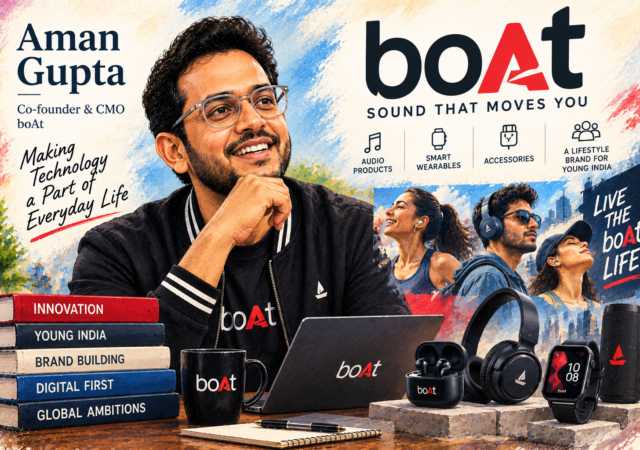
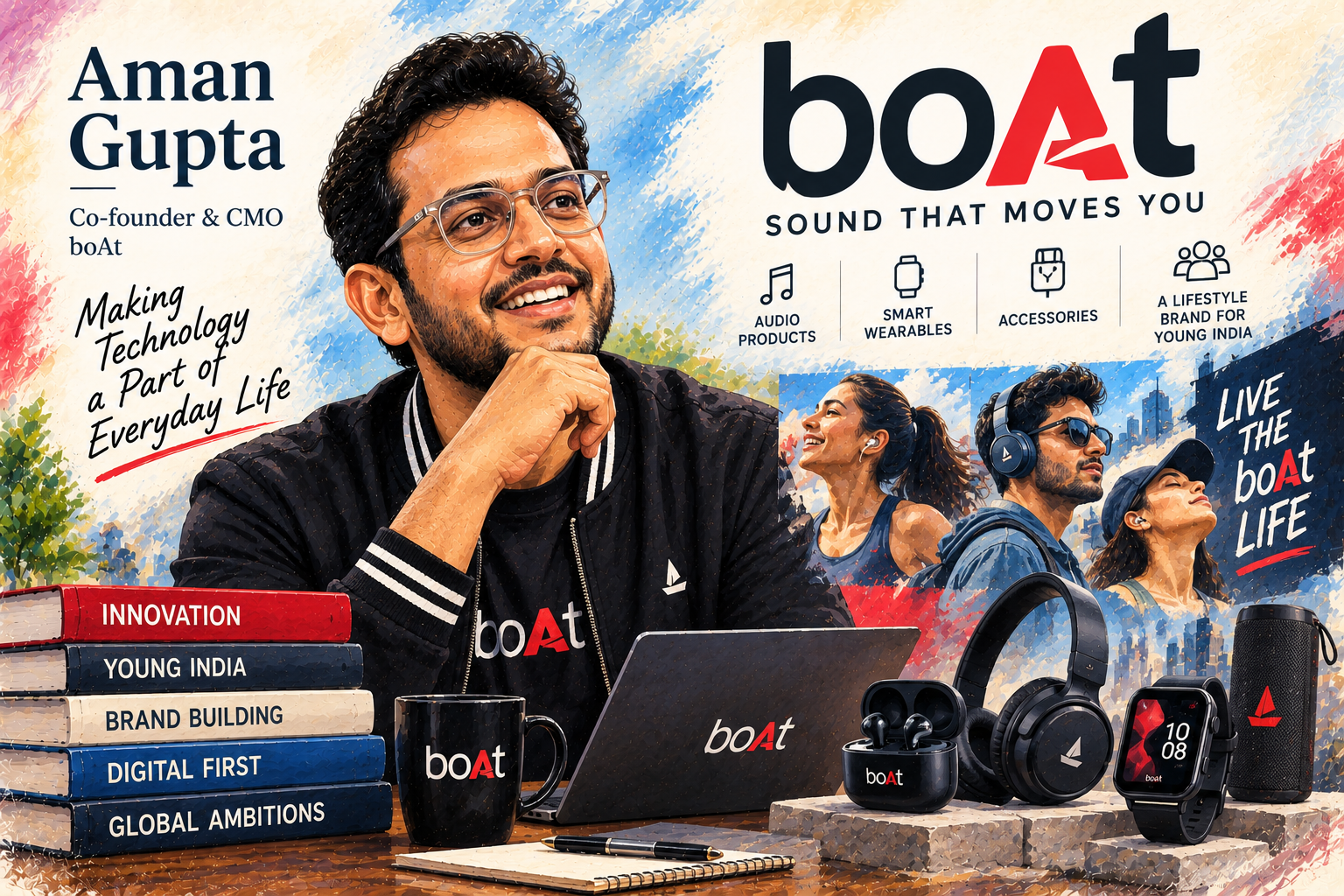
Aman Gupta is among the best-known entrepreneurs in India’s startup ecosystem, largely because of his role in building boAt and his appearance as an investor on Shark Tank India. His business journey demonstrates how a company can compete in a crowded consumer electronics market without relying exclusively on technological breakthroughs or the reputation of a multinational corporation. By combining accessible pricing, distinctive product design, digital distribution and aspirational branding, boAt built a strong identity in India’s personal audio market.
However, boAt is not a one-person success story. Aman Gupta co-founded the business with Sameer Mehta, and the company operates under Imagine Marketing Limited. While Gupta became the public face of the brand through marketing and television appearances, the company’s growth also depended on product sourcing, distribution, financial management and operational execution.
The boAt story is particularly relevant for Indian entrepreneurs because it shows how businesses can identify gaps between expensive international brands and lower-priced alternatives, then develop a proposition that customers find attractive. It also highlights the challenges of sustaining growth when competition increases, consumer preferences change and a brand expands into new product categories.
Who Is Aman Gupta?
Aman Gupta is an Indian entrepreneur, qualified chartered accountant and co-founder of boAt. Before becoming widely recognised as a startup investor, he developed experience across finance, consumer electronics and commercial management. His professional background helped him understand both the financial discipline required to operate a company and the importance of connecting products with consumer needs.
Gupta’s experience included working with consumer electronics and audio-related businesses, including Harman International. This exposure gave him insight into how audio products were positioned, distributed and marketed. He subsequently joined forces with entrepreneur Sameer Mehta to build a consumer brand suited to Indian buyers.
The founders recognised that personal audio products were no longer purchased only for their technical function. Earphones, headphones and speakers had become everyday accessories associated with entertainment, travel, fitness, work and personal style. Consumers increasingly wanted products that looked attractive, performed reliably and were available at accessible prices.
This combination of commercial understanding and consumer insight became central to boAt’s positioning. Instead of competing only on specifications, the company sought to make its products part of the lifestyle of young, digitally connected Indian consumers.
According to the company’s official founder and leadership information, Gupta and Mehta are founding members of Imagine Marketing. Their complementary contributions helped establish the foundation for the brand’s expansion.
The Birth of boAt: Identifying a Gap in the Market
Imagine Marketing was established in 2013, while the boAt brand emerged in 2016. The business initially explored consumer accessories and distribution before developing its own product identity. This early phase allowed the founders to gain experience in sourcing, product positioning and online retail.
The opportunity was visible in the Indian electronics market. Established international brands had strong reputations, but many of their products were relatively expensive for price-sensitive consumers. At the other end of the market, low-cost alternatives could offer attractive prices but did not always provide the combination of design, durability, warranty and brand credibility that customers wanted.
The founders identified an opportunity between these two segments. They could develop fashionable, reasonably priced accessories that offered a compelling balance between quality, design and affordability.
One of boAt’s early products was a durable charging cable designed to address a common frustration: cables that became damaged around their connectors. Rather than launching with a large range of complicated devices, the company began by addressing a familiar problem with a product that customers could easily understand.
This was an important business decision. A startup does not necessarily need to invent an entirely new category to build a successful company. It can create value by improving an existing product, making it more accessible, communicating its benefits clearly and distributing it effectively.
The founders subsequently expanded into earphones, headphones, speakers and other consumer electronics categories. Their strategy was to develop products around practical use cases while giving them a distinctive visual identity.
Understanding boAt’s Business Model
boAt’s business model centres on developing, marketing and selling consumer electronics and lifestyle accessories under its own brand. Its product range has included wired and wireless earphones, headphones, Bluetooth speakers, soundbars, smartwatches, charging accessories and other connected devices.
The company does not need to manufacture every component in its own factories to build a consumer brand. Instead, product development, design, sourcing, quality requirements, brand management and distribution can be coordinated with manufacturing partners. This approach can reduce the capital required for establishing large manufacturing facilities, although it creates dependence on suppliers and requires careful quality control.
The model also allows the company to concentrate resources on understanding consumers, identifying attractive product categories and creating demand. When a product performs well, the company can use its distribution network and brand recognition to expand its reach.
Revenue is generated through the sale of products across online marketplaces, its own digital channels and offline retail partners. The economics depend on the selling price, manufacturing and sourcing costs, logistics, marketplace commissions, marketing expenditure, warranty costs and retailer margins.
This distinction is important because high sales do not automatically translate into high profits. Consumer electronics is a competitive category in which pricing pressure, product returns, inventory management and promotional spending can significantly affect margins.
boAt’s business model therefore depends on more than selling large quantities of earphones. It must continually identify products customers want, manage sourcing costs, maintain quality and ensure that its marketing expenditure generates profitable demand.
How boAt Built Its Brand Among Young Consumers
One of boAt’s most important strategic decisions was to position itself as a lifestyle brand rather than simply an electronics manufacturer. The products were designed to appeal to consumers who wanted technology that reflected their preferences and identity.
The brand developed a youthful communication style, distinctive packaging and product designs that stood out in a market often dominated by technical specifications. Its identity was associated with music, entertainment, fitness and everyday mobility.
This approach helped boAt connect with customers emotionally as well as functionally. A buyer might compare two pairs of earphones on price, battery life and sound quality, but brand familiarity, colour options, design and social influence can also affect the final decision.
The company reinforced this positioning through the concept of the “boAthead” community. Customers were encouraged to identify with the brand rather than treat their purchases as isolated transactions. Such community-building can help increase brand recall, generate recommendations and make repeat purchases more likely.
The strategy also created opportunities for product launches to become marketing events. New models could be associated with particular activities, audiences or cultural trends rather than being promoted only through a list of technical features.
For entrepreneurs, the lesson is that brand identity should be built into the product, packaging, customer experience and communication strategy. A memorable brand is not created by a logo alone. It emerges when customers repeatedly encounter a consistent proposition.
Digital Marketing: Turning Visibility into Sales
Digital marketing played an important role in boAt’s expansion. Online marketplaces allowed the company to reach customers across India without first establishing a large network of physical stores. Product listings, customer reviews, targeted campaigns and promotional events helped the brand compete for attention.
Online platforms also gave the company access to customer feedback. Reviews and purchasing patterns can reveal which features customers appreciate, which products disappoint them and where a product needs improvement. Used effectively, this information can support decisions about design, pricing and future product development.
boAt also invested in influencer-led marketing and celebrity associations. Its campaigns have drawn on India’s strong interest in music, cricket and popular entertainment. Collaborations with public figures helped the brand reach audiences that might not have discovered it through conventional product advertising.
The effectiveness of this approach comes from matching the communication channel with the intended customer. Young consumers who follow musicians, athletes or entertainment personalities may respond more strongly to familiar cultural references than to traditional technical advertising.
However, influencer marketing has limitations. Reach and engagement do not necessarily translate into profitable sales. Businesses need to assess conversion rates, customer acquisition costs, repeat purchases and the incremental value of campaigns.
The broader lesson is to connect marketing activity with measurable business outcomes. A campaign should not be judged only by how many people saw it, but by whether it improved awareness, generated qualified demand and contributed to sustainable revenue.
The Role of E-Commerce and Distribution
boAt’s digital-first approach helped it establish a presence without immediately investing in a nationwide network of company-owned stores. Online channels offered access to a broad customer base and made it easier to test products and respond to demand.
The company also benefited from the growth of e-commerce in India. As more consumers became comfortable purchasing electronics online, brands could reach customers beyond major metropolitan markets. Product comparisons, reviews and promotional events made it easier for relatively young brands to compete with established names.
Over time, offline distribution became increasingly important as well. Physical retail gives customers an opportunity to see products, compare designs and assess comfort before purchasing. It can also help brands reach consumers who prefer buying electronics in person.
An omnichannel strategy can therefore increase market access, but it also creates operational complexity. A company must coordinate inventory, pricing, retailer relationships, promotional policies and product availability across multiple channels.
For boAt, the challenge is to ensure that online and offline sales support the same brand promise. Aggressive online discounts, for example, can create friction with retailers if price differences are not managed carefully.
The lesson for business owners is that distribution should evolve with customer behaviour. Digital channels can be excellent for launching and scaling a brand, but physical availability may become necessary as the company expands into new customer segments.
Expanding Beyond Earphones and Headphones
After establishing a presence in audio accessories, boAt expanded into additional categories, including speakers, soundbars and smartwatches. The strategic logic was straightforward: a recognised brand could potentially sell multiple products to the same customer.
Category expansion offers several advantages. It can increase the average value of a customer’s relationship with the company, improve brand visibility and create opportunities to use existing marketing and distribution capabilities across a wider range of products.
However, expansion also carries risks. Each category has its own competitors, product requirements, customer expectations and technology cycles. A brand that performs well in earphones cannot assume that it will automatically achieve the same position in smartwatches or other electronics.
This challenge became especially relevant as the wearables market grew more competitive and consumer demand changed. Product differentiation, software experience, reliability and after-sales support became important factors in addition to price and appearance.
A disciplined expansion strategy requires companies to evaluate market demand, competitive intensity, margins and their ability to deliver a strong customer experience. Entering a new category simply because the market is growing can result in excessive inventory and weak profitability.
boAt’s experience illustrates that brand extension works best when customers can understand why the brand belongs in the new category and when the company has the operational capabilities to deliver on that promise.
Competition and the Challenges of Sustainable Growth
boAt competes with established electronics companies, specialist audio brands and other value-focused consumer technology businesses. The competitive landscape can change quickly as new products enter the market and rivals use discounts, new features and marketing campaigns to attract customers.
Price is an important consideration in consumer electronics, but competing only on price can weaken profitability. If customers can easily switch between similar products, companies may be forced to increase discounts or advertising spending to maintain sales.
Product quality presents another challenge. A brand may attract first-time buyers through strong marketing, but repeat purchases depend on whether customers are satisfied with the product. Poor durability, unreliable connectivity, disappointing battery performance or weak after-sales service can damage trust.
Inventory management is equally important. Electronics products can lose relevance as technology and consumer preferences evolve. Holding too much stock increases the risk of discounting, while insufficient inventory can result in missed sales.
boAt’s long-term performance therefore depends on balancing innovation, product quality, cost control and marketing. The company must continue to build brand preference while ensuring that its products remain competitive and commercially viable.
Funding, Financial Performance and the IPO Journey
As boAt expanded, the business attracted external investment to support its growth. Investors saw an opportunity in a consumer brand that had developed significant visibility in India’s electronics market. Funding can help a business strengthen distribution, develop new products, invest in marketing and build the organisational capabilities needed to scale.
The parent company, Imagine Marketing Limited, has also explored a public listing. In October 2025, the company filed an updated draft red herring prospectus for a proposed ₹1,500 crore initial public offering, comprising a fresh issue and an offer for sale. The proposal followed an earlier IPO attempt in 2022. The company’s investor-relations page provides access to public filings and corporate information.
An IPO is a significant milestone, but it is not a guarantee of future success. Public-market investors examine revenue growth, profitability, cash flow, governance, competitive risks and the company’s ability to maintain its market position.
For boAt, the broader challenge is to demonstrate that brand strength can translate into durable financial performance. Investors will want to understand whether the company can defend its position in audio products, respond to changes in wearables demand and manage costs while continuing to innovate.
Because IPO plans and regulatory processes can change, the latest official filings should be checked before publishing any update about the listing’s status.
What Entrepreneurs Can Learn from Aman Gupta and boAt
The first lesson is to identify a clear gap in the market. boAt found an opportunity between expensive established products and less differentiated low-cost alternatives. Entrepreneurs should study how customers currently solve a problem and identify what they find expensive, inconvenient or disappointing.
The second lesson is that differentiation does not always require groundbreaking technology. Product design, durability, customer experience, packaging and positioning can create meaningful value even in an established category. The key is to offer a combination that customers recognise and are willing to pay for.
The third lesson is to build a brand that speaks to a defined audience. boAt’s youthful identity helped it stand out in consumer electronics. Businesses should understand their target customers’ lifestyles, aspirations and buying behaviour rather than trying to appeal to everyone.
The fourth lesson is to treat marketing as a business investment. Influencer campaigns, online advertising and sponsorships can increase awareness, but their impact should be measured through sales, customer acquisition costs, repeat purchases and profitability.
The fifth lesson is to expand carefully. Adding new products can increase revenue, but every category introduces operational and competitive risks. Entrepreneurs should test demand, understand margins and ensure that their teams can support the expansion.
Finally, a business must evolve beyond its founder’s public image. Aman Gupta’s visibility helped boAt attract attention, but a sustainable company needs strong products, capable leadership, reliable systems and customer trust. Founder-led marketing can accelerate growth, but it cannot replace sound execution.
Conclusion: More Than a Marketing Success Story
Aman Gupta and Sameer Mehta’s journey with boAt offers a valuable case study in building an Indian consumer brand. By identifying an underserved market, developing accessible products and combining e-commerce with lifestyle-led marketing, the founders created a recognisable name in personal audio and consumer electronics.
The story also highlights the realities of scaling a business. Competition, product quality, inventory, changing consumer preferences and profitability require continuous attention. A strong brand can help a company attract customers, but long-term success depends on delivering value consistently.
For aspiring entrepreneurs, boAt’s most important lesson is that successful businesses are built by connecting customer insight with product execution, distribution and a clear brand promise. Innovation can mean creating a new technology, but it can also mean understanding an existing market better and serving customers in a more compelling way.
Ultimately, boAt demonstrates how an Indian startup can challenge established players by finding its audience, communicating its value clearly and building a business model that can grow beyond its initial product.