
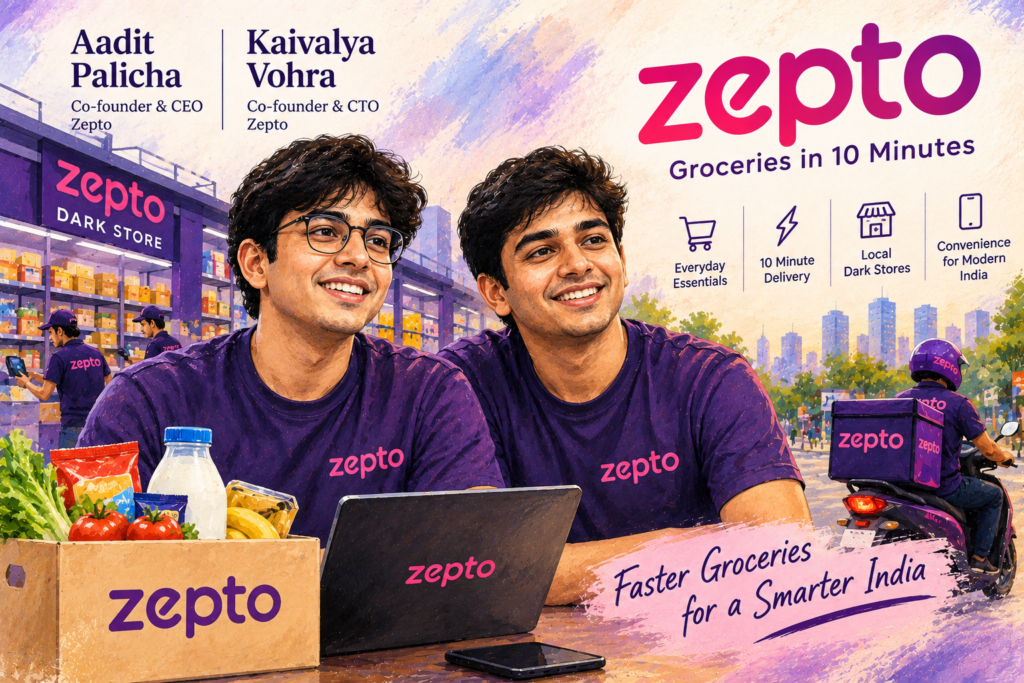
Introduction: The Young Founders Transforming Grocery Shopping in India
Imagine ordering milk, bread, vegetables, snacks or household essentials on your smartphone and receiving them within minutes. What once required a trip to the neighbourhood grocery store has increasingly become a service available through a mobile application. This transformation has created a new category of retail known as quick commerce, and one of its most prominent Indian companies is Zepto.
Founded in 2021 by Aadit Palicha and Kaivalya Vohra, Zepto has emerged as a major player in India’s rapidly evolving grocery delivery market. The company built its business around a simple proposition: customers should be able to purchase everyday essentials online and receive them quickly, without sacrificing the convenience of shopping from home.
The story of Zepto is particularly interesting because of the age of its founders and the scale of the challenge they chose to tackle. Rather than building another conventional e-commerce marketplace, they developed a business that combines technology, inventory management, local fulfilment centres and a delivery network designed for speed.
According to Zepto’s updated draft IPO filing in June 2026, the company reported revenue from operations of approximately ₹22,624 crore for FY2025–26, more than double its previous year’s revenue. However, its net loss also increased to approximately ₹5,905 crore, highlighting the financial challenges associated with rapid expansion. <Cite refs={[“turn197035news24″,”turn197035search3”]}/>
Zepto’s journey therefore offers two important perspectives for entrepreneurs. It demonstrates how founders can identify changing consumer behaviour and build a large business around it. At the same time, it highlights the difficulty of turning rapid growth into sustainable profitability.
Aadit Palicha and Kaivalya Vohra: The Founders Behind Zepto
Aadit Palicha and Kaivalya Vohra developed an interest in entrepreneurship and technology at a young age. Both studied at Stanford University before leaving their studies to focus on building their business. Their decision reflected a belief that an immediate market opportunity was worth pursuing rather than waiting until they had completed a conventional academic and professional journey.
Their entrepreneurial journey began with KiranaKart, an online grocery delivery venture that explored how customers could obtain everyday products more conveniently. The founders encountered practical challenges in making grocery delivery work efficiently, particularly when coordinating with local shops and fulfilling orders quickly.
These early experiences helped them understand that the conventional marketplace approach might not be sufficient to deliver the speed and reliability they wanted to offer. Grocery delivery involves more than receiving an online order. Products must be available, orders must be picked and packed, and delivery partners must transport them efficiently to customers.
The founders subsequently developed Zepto around a different operating model based on dedicated local fulfilment centres, commonly known as dark stores. These facilities are designed for preparing online orders rather than serving walk-in customers. By positioning inventory closer to consumers, the company could reduce the distance between the point of fulfilment and the customer’s address.
The transition from KiranaKart to Zepto illustrates an important entrepreneurial lesson: the original business idea may need to evolve when real-world experience reveals operational limitations. Successful founders must be willing to reconsider their assumptions and redesign their model when evidence suggests a better approach.
What Is Quick Commerce and Why Did Zepto Focus on It?
Quick commerce refers to the rapid delivery of groceries and other everyday products ordered through digital platforms. While traditional e-commerce may offer delivery within a day or several days, quick-commerce businesses focus on fulfilling orders within a much shorter period.
The model addresses a particular consumer need: convenience. Urban consumers often need small quantities of groceries, beverages, snacks, personal-care products or household essentials at short notice. They may not want to visit a store, plan a large weekly shopping trip or wait several hours for delivery.
Smartphone adoption, digital payments and changing urban lifestyles helped create favourable conditions for this business model in India. Consumers became increasingly comfortable ordering products online, while technology made it possible to coordinate inventory, payments, picking and delivery in real time.
Zepto entered this market with an emphasis on speed and a broad assortment of everyday essentials. Its proposition was not simply to bring products to customers but to make the entire shopping process feel almost immediate.
However, speed alone does not create a sustainable business. Grocery retail operates on relatively tight margins, and the cost of storing, handling and delivering products can be significant. A company must therefore balance delivery convenience with inventory availability, order density and operational efficiency.
Zepto’s strategy illustrates how a new customer experience can create a business opportunity, but also why the operational infrastructure behind that experience matters just as much as the mobile application.
The Dark Store Model: The Engine Behind Zepto
The dark-store model is central to understanding Zepto’s operations. Unlike a conventional supermarket, a dark store is designed primarily for online order fulfilment. Its shelves, inventory systems and picking processes are organised to help workers locate products and prepare orders quickly.
These facilities are typically located within or near the neighbourhoods they serve. When a customer places an order, the system identifies the relevant fulfilment location, checks product availability and sends the order to be picked and packed. A delivery partner then collects the order and transports it to the customer.
The advantage is proximity. A central warehouse serving an entire city may be efficient for bulk distribution, but it is less suitable for delivering individual grocery orders within a few minutes. Smaller fulfilment centres located closer to consumers can reduce delivery distances and make rapid fulfilment more practical.
Dark stores also allow businesses to manage inventory more systematically than a loosely coordinated network of independent neighbourhood retailers. The company can monitor product availability, analyse demand patterns, plan replenishment and organise picking routes within the facility.
However, the model requires substantial investment. Each location needs space, inventory, refrigeration where necessary, staff, technology and regular replenishment. A dark store that receives too few orders may struggle to cover its fixed costs, while a busy location must maintain adequate stock and process orders efficiently during peak periods.
Zepto’s updated IPO filing reported that the company operated 1,139 dark stores at the end of FY2025–26. This network demonstrates the scale of infrastructure required to support its quick-commerce ambitions. <Cite refs={[“turn197035search1″,”turn197035search9”]}/>
For entrepreneurs, the lesson is that operational design can be a competitive advantage. The company’s success depends not just on attracting customers but also on creating an infrastructure that fulfils orders quickly, consistently and economically.
How Zepto Makes Money
Zepto’s business model combines retail sales, brand partnerships and services connected to its digital platform. Its core business involves selling groceries and everyday products to consumers through its application.
The company earns revenue through the sale of products, with its financial performance depending on purchasing costs, selling prices, product mix, discounts, fulfilment expenses and other operating costs. Unlike a pure marketplace that merely connects buyers and sellers, quick-commerce businesses must carefully manage the economics of inventory and fulfilment under their particular operating structures.
The company also works with consumer brands that want to reach customers through its platform. Brands can benefit from product visibility, promotional campaigns and access to consumers who are already shopping for related categories. Advertising and brand-partnership services can create additional revenue streams beyond the sale of merchandise.
These services are commercially important because retail margins can be narrow. A platform that understands what customers search for and purchase can offer brands opportunities to promote relevant products. However, advertising revenue must be managed carefully so that commercial promotions do not undermine the customer experience.
Delivery-related charges, subscriptions and promotional arrangements may also influence the economics of individual orders, depending on the applicable customer offering. The exact contribution of each revenue stream varies over time and should be evaluated using the company’s financial disclosures.
The central challenge is to generate sufficient revenue from each order to cover product costs and the expenses of fulfilling it. Those expenses can include warehouse operations, picking and packing, delivery, technology, customer acquisition and corporate overheads.
A large order volume can improve the economics of a dark store because fixed costs are spread across more transactions. But volume alone does not guarantee profit. The business must also manage discounts, wastage, delivery efficiency and the cost of acquiring and retaining customers.
The Competition: Blinkit, Instamart and India’s Quick-Commerce Race
Zepto operates in a fiercely competitive market that includes Blinkit, Swiggy Instamart and other grocery delivery services. These companies compete for customer attention through delivery speed, product availability, pricing, promotions and convenience.
Competition has encouraged businesses to expand their store networks and improve fulfilment systems. A company with more appropriately located stores may be able to serve more neighbourhoods, reduce delivery distances and provide customers with a wider assortment of products.
However, opening additional stores also creates financial commitments. Each new location requires investment and must generate sufficient order volume to become economically productive. Companies that expand too quickly may increase revenue while simultaneously putting pressure on profitability and cash flow.
Zepto’s competitive position depends on several factors: how frequently customers order, how many products they purchase, how efficiently stores fulfil orders and how well the company manages the cost of delivery. Customer retention is especially important because repeat orders can reduce dependence on expensive promotional campaigns.
Competition also extends beyond delivery time. Customers compare prices, product availability, substitutions, service reliability and the overall experience. A business that promises rapid delivery but frequently lacks essential products may struggle to retain customers.
For entrepreneurs, this demonstrates that a compelling headline proposition is only the starting point. Long-term differentiation comes from consistently delivering value and building an operating system that competitors cannot easily replicate.
Rapid Growth Versus Profitability
Zepto’s financial performance illustrates one of the biggest challenges in the quick-commerce industry: balancing growth with profitability.
According to the company’s updated draft IPO filing, revenue from operations increased from approximately ₹11,110 crore in FY2024–25 to ₹22,624 crore in FY2025–26. During the same period, its net loss widened from approximately ₹4,700 crore to ₹5,905 crore. <Cite refs={[“turn197035news24″,”turn197035search11”]}/>
These figures show why revenue growth should not be considered the sole measure of success. A company may increase sales rapidly by opening more stores, offering discounts, spending on marketing and expanding its delivery network. But if the costs of those activities grow faster than the business’s ability to generate sustainable returns, losses can continue to rise.
There are, nevertheless, important operational metrics that can improve as the business scales. Higher order volumes at individual stores can increase inventory turnover, improve labour utilisation and spread fixed costs across more transactions. More efficient picking and delivery can also reduce the cost of serving each customer.
Industry reporting on Zepto’s FY2026 disclosures noted that its all-in cost per order declined as order volumes and network utilisation improved, even though the company remained loss-making. <Cite refs={[“turn197035search7″,”turn197035search16”]}/>
This distinction matters. Improving unit economics is an encouraging development, but it does not automatically mean the entire business has reached profitability. The company must continue to manage expansion costs, operating expenses, cash requirements and competition.
For founders, the lesson is to monitor both growth indicators and financial fundamentals. Revenue, order volume and customer acquisition should be evaluated alongside contribution margins, cash flow, store productivity and the time required for new locations to become profitable.
Zepto’s IPO Journey and the Importance of Investor Confidence
As Zepto expanded, it increasingly attracted attention from investors interested in India’s consumer internet and quick-commerce markets. External funding helped support its growth ambitions, technology investments and store expansion.
The company also moved towards a public-market listing. In June 2026, Zepto filed updated draft IPO documents outlining plans to raise capital through a public issue. Reuters reported that the proposed issue could raise up to approximately ₹8,370 crore, subject to the final offering structure and applicable approvals. <Cite refs={[“turn197035news24”]}/>
An IPO can provide a company with capital for expansion, technology infrastructure and other business requirements. It also creates a broader shareholder base and subjects the company to public-market reporting and governance expectations.
For a high-growth company such as Zepto, the public-market challenge is to demonstrate that rapid expansion can eventually produce sustainable financial returns. Investors need to evaluate the quality of revenue growth, operating performance, competitive risks, cash requirements and the assumptions underlying future profitability.
The company’s public filings also disclose risks, including its history of losses, reliance on dark stores, the need to acquire and retain customers, competition and regulatory requirements. These disclosures are important because they show that a fast-growing startup can present both a significant business opportunity and substantial risks.
An IPO should therefore not be treated as proof that a business model is successful. It is a financing and ownership milestone, while the company’s long-term performance depends on execution, governance and financial discipline.
Five Business Lessons Entrepreneurs Can Learn from Zepto’s Founders
The first lesson is to identify a real customer problem. Zepto’s founders focused on the inconvenience of obtaining everyday products quickly. They developed a service around a clear consumer need rather than starting with technology and searching for a problem to solve.
The second lesson is to redesign operations around the customer promise. Rapid delivery required more than an attractive application. Zepto needed local inventory, efficient picking processes, technology and a delivery network. Entrepreneurs should ensure that their internal systems support what they promise to customers.
The third lesson is to adapt when the original model does not work well enough. The founders’ early experience with KiranaKart helped them understand the operational limitations of their initial approach. Their transition towards a dark-store-based model demonstrates the importance of testing assumptions and responding to practical evidence.
The fourth lesson is to understand unit economics before expanding aggressively. Opening new locations can increase revenue, but each location must have a credible path towards covering its costs. Businesses should measure profitability at the product, customer, location and overall company levels wherever possible.
The fifth lesson is to build a business that can survive intense competition. Customer convenience may attract initial interest, but long-term success requires reliable service, competitive pricing, product availability and financial resilience. Entrepreneurs must continuously improve their offering while avoiding growth strategies that create unsustainable cash requirements.
Conclusion: Is Zepto’s Model the Future of Retail?
Aadit Palicha and Kaivalya Vohra have helped establish Zepto as one of the major names in India’s quick-commerce market. Their journey demonstrates how young entrepreneurs can identify changing consumer behaviour, rethink traditional retail operations and build a large technology-enabled business.
The company’s dark-store model, rapid fulfilment strategy and focus on everyday essentials have helped it scale. At the same time, its financial results show that growth at scale can involve substantial investment and persistent profitability challenges.
Zepto’s long-term success will depend on whether it can convert its growing customer base and store network into sustainable financial performance. Higher order density, efficient inventory management, better fulfilment economics and disciplined expansion will all play important roles.
For aspiring entrepreneurs, the most valuable lesson is that a successful startup is built through the combination of customer insight, operational innovation and sound financial management. Zepto’s story is not simply about delivering groceries in minutes. It is about redesigning an entire business system around a customer promise—and the challenge of making that system economically sustainable.