
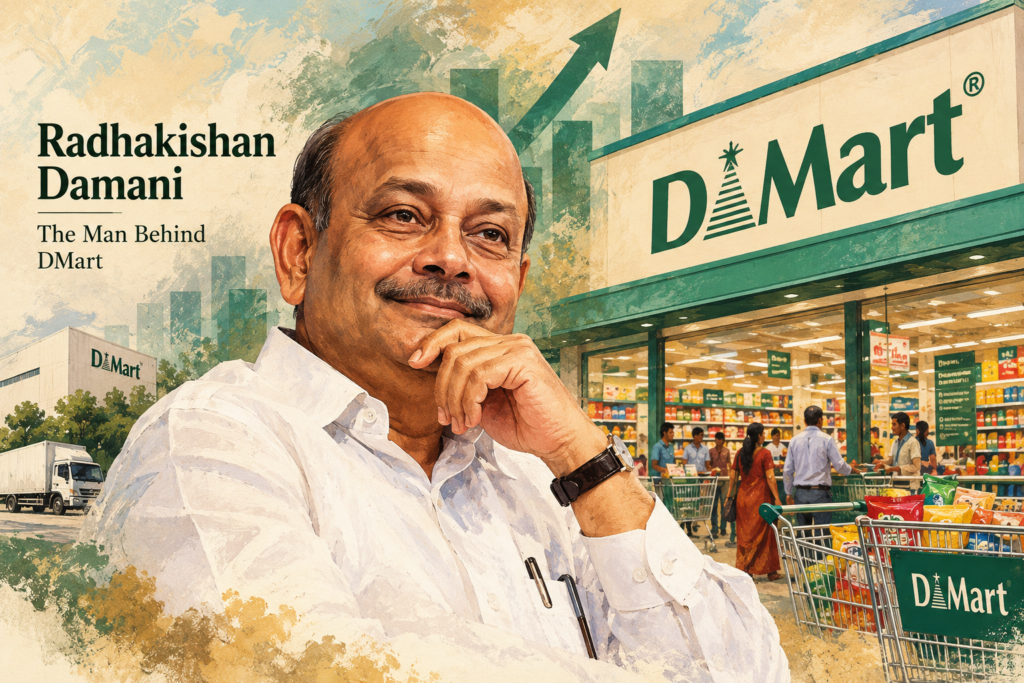
In a retail market where businesses compete through advertising, attractive store designs, discounts and rapid expansion, DMart has followed a remarkably different path. Its proposition is straightforward: offer customers good-quality products at competitive prices while maintaining tight control over operating costs. This simple idea has helped the company build a powerful position in India’s organised retail sector.
Behind this business stands Radhakishan Damani, one of India’s best-known entrepreneurs and investors. Unlike business leaders who frequently appear in the media, Damani has maintained a relatively low public profile. His business philosophy, however, has attracted considerable attention from investors, entrepreneurs and retail professionals.
DMart operates under Avenue Supermarts Limited, a publicly listed company founded by Damani. Its journey offers an interesting case study in understanding consumer behaviour, managing cash flow, controlling costs and building a business with a long-term perspective. Rather than relying exclusively on aggressive marketing or rapid expansion, DMart has built its business around everyday value, disciplined execution and a carefully developed operating model.
The company’s performance demonstrates the scale this approach can achieve. In financial year 2025–26, Avenue Supermarts reported standalone revenue from operations of approximately ₹66,968 crore and profit after tax of around ₹3,224 crore. By March 2026, DMart had expanded to 500 stores, according to its annual report. These numbers illustrate how a business focused on everyday consumer needs can develop into a major retail enterprise.
Radhakishan Damani: From Investor to Entrepreneur
Radhakishan Damani initially became widely known in India’s financial markets through his work as an investor. His investment approach was associated with patience, careful evaluation of businesses and an emphasis on financial fundamentals. Over time, his understanding of consumer behaviour and the economics of businesses helped him identify an opportunity in organised retail.
Retail is a demanding business. Companies must purchase products, manage inventory, negotiate with suppliers, operate physical locations, employ staff and serve customers consistently. Even when sales are strong, profitability can be affected by rent, wastage, logistics, discounts and working capital requirements. A retailer therefore needs more than attractive products or a popular brand; it needs a sustainable operating system.
Damani recognised the potential of serving consumers who wanted quality products without paying unnecessarily high prices. His retail venture eventually developed into DMart, which opened its first store in Powai, Mumbai, in 2002. The business was built around a clear customer promise: everyday products at prices that offered genuine value.
His transition from investing to building an operating business is an important part of the DMart story. Investors analyse companies and allocate capital, while entrepreneurs must build systems, manage employees, solve operational problems and satisfy customers repeatedly. Retail brought these responsibilities together. Damani’s background in evaluating business fundamentals provided a useful perspective, but the company’s long-term performance also depended on execution by its wider organisation.
DMart’s growth was gradual rather than purely expansion-driven. The company concentrated on developing its operating model, strengthening its presence in existing markets and establishing a reputation for value. This approach helped it build a business where customers had a practical reason to return: the possibility of saving money on their regular household purchases.
What Is the DMart Business Model?
DMart follows a value-retail model centred on selling everyday consumer goods at competitive prices. Its stores stock groceries, packaged food, personal-care products, household essentials, clothing, kitchenware and other merchandise. The range allows customers to purchase several categories of products during a single shopping trip.
The company earns revenue by purchasing goods from manufacturers and suppliers and selling them to consumers through its retail network. Its commercial success depends on the difference between the selling price and the cost of products, together with its ability to manage store expenses, inventory, logistics and other operating costs.
The distinctive feature of DMart is not simply that it offers discounts. Many retailers offer discounts, particularly during festivals and promotional campaigns. DMart’s model aims to make competitive pricing a consistent part of the shopping experience rather than relying only on temporary promotions.
This distinction matters because regular household purchases are repeated frequently. Customers buying groceries, detergents, toiletries and packaged foods are often sensitive to price differences. If they consistently find attractive prices at a nearby store, they have a reason to return. Over time, this behaviour can generate repeat purchases and customer loyalty.
The model also benefits from a relatively focused product mix. Everyday essentials form a substantial part of the business, while general merchandise and apparel broaden the range. In FY2025–26, food products accounted for approximately 57.9% of the company’s revenue from its retail business, according to its annual report. This reflects the importance of recurring household consumption in DMart’s business.
The central principle is straightforward: generate sales through a relevant assortment of products, keep prices competitive, control the cost of delivering those products and encourage customers to return regularly. Executing this principle consistently across hundreds of stores is the real challenge—and a major part of DMart’s competitive strength.
Everyday Low Prices: The Strategy That Differentiates DMart
One of the most important elements of DMart’s strategy is its emphasis on everyday low prices. Instead of positioning itself as a premium shopping destination, the company focuses on helping households manage their regular expenses. This positioning appeals to price-conscious consumers who purchase groceries and household products frequently.
The strategy creates a different relationship between the retailer and its customers. A customer may visit a store for a festival discount or a seasonal sale, but regular household purchases depend on consistent value, convenience and product availability. DMart seeks to make its stores attractive for routine shopping rather than occasional visits.
Competitive pricing also requires discipline behind the scenes. Retailers cannot reduce prices indefinitely without affecting profitability. They must negotiate effectively with suppliers, select products carefully, control operational expenses and ensure that inventory moves at a healthy rate. DMart’s business model brings these elements together to support its value proposition.
For entrepreneurs, the lesson is that a strong selling proposition must be supported by the underlying economics of the business. Offering lower prices is not a sustainable competitive advantage if every sale generates a loss. The challenge is to develop an operating structure that allows customers to receive value while the business remains financially viable.
Cost Control: The Foundation of DMart’s Success
Cost management is central to understanding DMart’s business. In retail, expenses extend far beyond the purchase price of merchandise. Store rentals, employee salaries, electricity, warehousing, transportation, inventory handling, technology and administration all influence profitability.
A retailer that carries excessive costs may struggle to offer competitive prices. DMart’s approach has therefore placed considerable emphasis on operating efficiency and financial discipline. Its focus on practical store operations, product selection and supply-chain efficiency supports its objective of offering customers good value.
Store location is another important consideration. Retailers must balance customer accessibility with property costs, expected sales and the time required for a new location to become productive. Expanding into a new market can create long-term opportunities, but it also introduces operational complexity and financial commitments.
DMart’s cluster-based expansion approach reflects this need for discipline. Rather than spreading its presence indiscriminately, the company has sought to deepen its presence in areas where it already operates before entering additional markets. Its FY2025–26 annual report recorded 500 stores at the end of March 2026, compared with 415 a year earlier. This expansion was accompanied by a substantial investment in retail space and supporting infrastructure.
The broader lesson is that growth should be evaluated in terms of its economic contribution, not simply the number of locations opened. A business owner should understand the expected sales, costs, cash requirements and payback period of each new outlet before committing capital. DMart’s approach illustrates why expansion decisions need to be connected to operational capacity and financial fundamentals.
Supplier Relationships and Inventory Management
The relationship between a retailer and its suppliers can significantly influence product availability, pricing and profitability. A large retailer may have the opportunity to negotiate commercial terms, but scale alone does not guarantee success. Suppliers also evaluate payment reliability, order predictability, product movement and the quality of the business relationship.
DMart’s emphasis on everyday essentials creates recurring demand across many product categories. This helps the business build a regular purchasing and replenishment cycle. A retailer that understands what customers buy, how quickly products sell and when inventory needs replenishment can reduce the risk of excessive stock and lost sales.
Inventory management is particularly important in grocery retail. Products can have limited shelf lives, seasonal demand patterns or changing consumer preferences. Excess stock ties up working capital and can lead to wastage or markdowns, while insufficient stock means customers may not find the products they need.
A well-managed retail operation therefore needs accurate demand forecasting, reliable supplier coordination and frequent monitoring of stock levels. DMart’s distribution centres, packing centres and store network form part of the infrastructure required to support its retail operations. At the end of FY2025–26, the company reported 84 distribution centres and 12 packing centres.
For smaller businesses, the principle is equally relevant. A manufacturer, distributor or shop owner can improve profitability by identifying slow-moving inventory, negotiating sensible purchasing terms and aligning procurement with actual demand. Better inventory discipline can release cash that would otherwise remain locked in unsold stock.
How DMart Makes Money
DMart’s financial performance helps explain why its business model attracts attention. Avenue Supermarts reported standalone revenue from operations of approximately ₹57,790 crore in FY2024–25 and ₹66,968 crore in FY2025–26. Standalone profit after tax increased from approximately ₹2,927 crore to ₹3,224 crore over the same period.
These figures demonstrate the scale of the business, but revenue alone does not explain retail profitability. A retailer can generate substantial sales while earning relatively modest margins. The financial outcome depends on merchandise costs, operating expenses, the productivity of its stores and the amount of capital required to support expansion.
DMart’s strategy is to combine high-volume sales with disciplined costs and competitive pricing. Everyday products encourage repeat purchases, while a broad assortment enables customers to buy multiple categories in one visit. Store productivity and supply-chain efficiency are important because small improvements across a large network can have a meaningful impact on the overall business.
It is also important to distinguish between standalone and consolidated financial results when analysing the company. The two measures cover different reporting scopes, and figures should not be mixed in the same comparison without explanation. Entrepreneurs studying DMart should examine revenue growth, profitability, cash flow, capital expenditure and store productivity together instead of treating sales growth as the only indicator of success.
DMart Ready and the Challenge of Online Retail
Consumer shopping habits are evolving, with customers increasingly using mobile applications and online platforms to purchase groceries and household products. This has created opportunities for traditional retailers to extend their reach through digital channels, but it has also introduced new operational challenges.
DMart operates an online grocery business under the DMart Ready brand. Its presence in digital retail allows the company to serve customers who value the convenience of ordering online. However, online grocery retail involves costs associated with fulfilment, order preparation, technology, transportation and last-mile delivery.
These expenses can make online operations more difficult to scale profitably than they may initially appear. Customers often expect quick deliveries and competitive prices, while retailers must cover the cost of picking, packing and transporting relatively low-value orders.
The emergence of quick-commerce companies has intensified competition in this market. Customers can increasingly choose between visiting a supermarket, placing a scheduled online order or receiving products through a rapid-delivery service. Each model has a different cost structure and customer proposition.
For DMart, the challenge is to combine its value-led retail identity with the convenience expectations of modern consumers. For entrepreneurs, this highlights an important principle: adopting a new channel is not enough. Businesses must understand the economics of that channel and determine whether it strengthens customer relationships without undermining profitability.
What Entrepreneurs Can Learn from Radhakishan Damani and DMart
The first lesson is the importance of a clearly defined customer proposition. DMart’s focus on competitive prices is easy for customers to understand. Businesses often weaken their positioning by attempting to appeal to everyone through too many products, inconsistent pricing or unclear messaging. A strong proposition gives customers a compelling reason to choose one business over another.
The second lesson is that operational efficiency can be a powerful competitive advantage. Advertising and brand visibility may attract customers, but long-term profitability depends on how effectively a company delivers its products or services. Entrepreneurs should examine procurement, inventory, staffing, distribution and administrative expenses to identify avoidable costs.
The third lesson concerns financial discipline. Growth requires investment, and expansion can consume substantial amounts of cash before a new location or product becomes profitable. Business owners should evaluate expected returns, working capital requirements and downside risks before committing funds. Revenue growth is valuable only when it contributes to a sustainable business.
The fourth lesson is the value of patience. Building a strong retail network takes time. New locations require planning, supplier relationships must be developed and operating systems need to mature. Entrepreneurs can benefit from establishing a repeatable business model before expanding aggressively into new markets.
The fifth lesson is to understand customer behaviour rather than relying on assumptions. DMart’s focus on everyday necessities reflects the importance of serving recurring consumer needs. Business owners should regularly examine purchase patterns, customer feedback, repeat business and price sensitivity. Decisions grounded in actual customer behaviour are generally more useful than decisions based solely on competitors’ activities.
Finally, the DMart story demonstrates the importance of aligning strategy with execution. A low-price promise, for example, must be supported by procurement, logistics, store operations and financial management. When different parts of the business work toward the same objective, the company is better positioned to deliver a consistent customer experience.
Conclusion
Radhakishan Damani’s journey with DMart offers a valuable example of how a clearly defined business model, disciplined execution and a focus on everyday consumer needs can support long-term growth. The company has developed a substantial retail presence by concentrating on competitive pricing, operational efficiency, inventory management and a carefully considered expansion strategy.
Its success does not mean that the same formula will work for every business. Retail economics differ across markets, and the growth of online shopping and quick commerce continues to change consumer expectations. Nevertheless, DMart’s underlying principles remain relevant to entrepreneurs across industries.
Businesses do not always need an entirely new product or a revolutionary idea to build a competitive advantage. Sometimes, the opportunity lies in serving an existing need more efficiently, delivering consistent value and managing resources better than competitors.
For entrepreneurs studying successful Indian businesses, DMart is a reminder that sustainable growth is built through the combination of customer understanding, financial discipline and operational excellence. That combination, rather than expansion alone, is what makes its business model worth studying.