
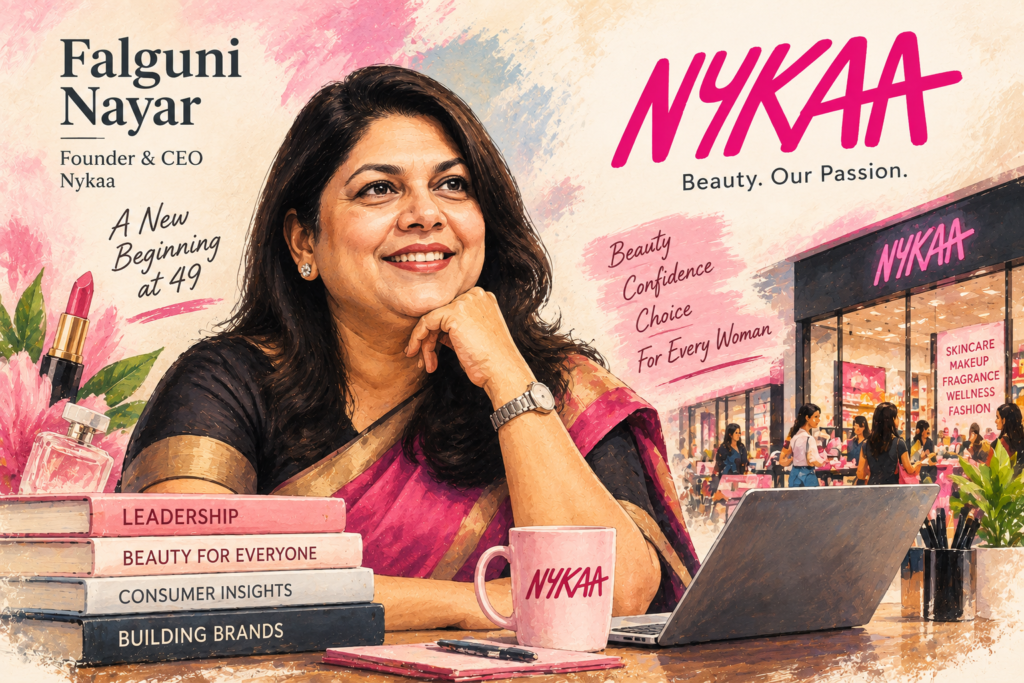
Introduction: A New Beginning at 49
Starting a business after decades in a corporate career may appear risky, particularly when many people believe entrepreneurship is a pursuit best suited to younger founders. Falguni Nayar challenged that assumption when she founded Nykaa in 2012 at the age of 49. After spending nearly two decades in investment banking, she decided to leave a successful corporate career and build a consumer business of her own.
Today, Nykaa is one of India’s best-known beauty and lifestyle retail businesses. Its journey from an online beauty platform to a company spanning e-commerce, physical stores, fashion and owned consumer brands illustrates how a founder can identify an underserved market and build a business around a clear customer need.
Nayar’s story is particularly relevant in India’s startup ecosystem, where entrepreneurship is frequently associated with young founders, technology products and venture capital funding. Her experience demonstrates that professional expertise, market understanding and a well-defined business opportunity can be powerful foundations for building a company, regardless of when an entrepreneur starts.
The success of Nykaa was not simply the result of launching an online shopping website. It involved building consumer trust, addressing concerns about product authenticity, educating customers about beauty products and developing relationships with established brands. These elements helped the company distinguish itself in a competitive retail market.
From Investment Banking to Entrepreneurship
Before founding Nykaa, Falguni Nayar built a distinguished career in finance. An alumna of the Indian Institute of Management Ahmedabad, she worked in investment banking and became a senior executive at Kotak Mahindra Capital Company. Her responsibilities included working with businesses on capital markets transactions, corporate finance and investment banking assignments.
This experience gave her exposure to business strategy, financial performance, capital allocation and the factors that influence the growth of companies. It also provided an understanding of how businesses create value over time and how financial discipline supports expansion.
However, a successful corporate career does not necessarily eliminate the desire to build something independently. After years of working with businesses and understanding their growth journeys, Nayar decided to apply her experience to an opportunity she saw in India’s consumer market.
Beauty and personal care products represented a promising area. Demand for cosmetics, skincare, haircare and related products was growing, but consumers often faced difficulties discovering suitable products, accessing international brands and finding reliable information before making a purchase.
Nayar saw an opportunity to create a platform that would make beauty products more accessible to Indian consumers. Instead of treating beauty as a narrow category, she envisioned a broader shopping and discovery experience supported by product information, curation and trusted brands.
In 2012, she launched Nykaa, marking the beginning of a new chapter in her professional life. The decision involved moving from a well-established corporate position into the uncertainties of entrepreneurship. It also required her to build capabilities in retail operations, technology, marketing and consumer engagement.
Her journey offers an important lesson for aspiring entrepreneurs: previous professional experience can become a valuable business asset when it is applied to a genuine market opportunity.
The Business Opportunity That Inspired Nykaa
When Nykaa entered the market, India’s beauty retail landscape was different from what consumers experience today. Many customers relied on physical stores, department stores, local retailers and beauty counters to discover and purchase products. Online shopping was developing, but buying cosmetics and skincare products online introduced concerns about authenticity, suitability and the reliability of product information.
Beauty is a category in which consumers often want to understand ingredients, application techniques, product performance and differences between brands before purchasing. A simple online catalogue may not be sufficient to address these needs.
Nykaa sought to combine product discovery with e-commerce. Its platform offered a curated selection of beauty products alongside descriptions, editorial content, tutorials and other resources designed to help consumers make informed choices.
The company also recognised that trust was essential. Consumers buying branded cosmetics and skincare products want confidence that the products are genuine and have been sourced through appropriate channels. By building relationships with brands and investing in its retail operations, Nykaa aimed to establish itself as a dependable destination for beauty shopping.
This strategy addressed more than the convenience of ordering products online. It attempted to solve several connected problems: limited product discovery, fragmented information, concerns about authenticity and the difficulty of exploring a broad range of brands in one place.
For entrepreneurs, this is an important example of customer-centric business development. A successful company often emerges when a founder identifies multiple frustrations within a customer journey and builds a service that addresses them together.
How Nykaa Makes Money
Nykaa’s business model has evolved beyond its original online beauty retail offering. Its operations span beauty and personal care, fashion, physical stores, owned brands and business-to-business distribution activities.
The core beauty business sells products from Indian and international brands through its digital platforms and retail stores. Revenue is generated through product sales, with profitability depending on factors such as purchase costs, selling prices, product mix, logistics, marketing and operating expenses.
The company’s online platform allows consumers to explore a wide range of products, compare options and shop from different categories. Its physical stores complement the digital business by allowing customers to discover products in person, receive assistance and experience brands before purchasing.
Nykaa has also developed its own portfolio of consumer brands. These include Nykaa Cosmetics, Kay Beauty, Dot & Key, Nykaa Wanderlust and other products across beauty, skincare and lifestyle categories. Owned brands provide an additional business opportunity because the company can participate more directly in product development, positioning and brand building.
Fashion is another part of the company’s broader strategy. Through Nykaa Fashion and related offerings, it seeks to serve consumers beyond beauty products. The expansion creates opportunities to reach existing customers through additional categories, although fashion has its own competitive dynamics, inventory requirements and profitability challenges.
The company’s growth illustrates the potential of combining retail distribution with brand ownership. A retailer can earn revenue by selling products made by others, while its own brands offer an additional route to differentiation. However, private-label and owned-brand businesses also require investments in product development, quality control, marketing and consumer research.
For entrepreneurs, the key lesson is that business models can evolve as companies develop a deeper understanding of their customers. Expansion into new categories is most effective when the new offering complements the original customer proposition rather than simply increasing the number of products available.
Content Marketing: How Nykaa Builds Consumer Trust
One of Nykaa’s distinctive features has been its emphasis on beauty-related content and consumer education. Beauty products are often associated with questions about skin types, ingredients, makeup techniques, skincare routines and the appropriate use of different products.
Content can help address these questions before a customer makes a purchase. Tutorials, product guides, expert recommendations and editorial articles can improve product discovery while helping consumers understand how products fit their needs.
This creates a connection between content marketing and commerce. A customer searching for information about skincare may discover a product through an educational article or tutorial and subsequently purchase it through the platform. The content therefore serves both an informational purpose and a commercial one.
The approach also helps build an ongoing relationship with customers. Rather than interacting with a retailer only when they need to buy something, consumers can return for advice, product discovery and inspiration.
This is a valuable lesson for businesses across industries. Companies do not always need to rely exclusively on advertising to attract customers. They can also publish useful information that addresses customer questions and helps people make better decisions.
For example, a financial services company can create educational guides about investment concepts, while a software business can publish practical tutorials. A business magazine can attract readers through founder stories, business case studies and industry analysis. When content addresses genuine user needs, it can contribute to search visibility, credibility and customer engagement.
Nykaa’s approach demonstrates how content can become an integral part of the customer experience rather than functioning merely as a promotional activity.
Building an Omnichannel Beauty Business
Although Nykaa began as a digital-first company, its expansion into physical retail has been an important part of its strategy. Beauty products often benefit from in-person discovery, particularly when customers want to test shades, explore textures or receive assistance selecting products.
Physical stores allow the company to provide experiences that an online platform cannot fully reproduce. They can also introduce the brand to consumers who prefer shopping in person or want to combine digital research with an in-store purchase.
An omnichannel strategy connects these experiences. Customers may discover products online, visit a store to explore them, and later purchase through a digital platform. The objective is to create a more consistent relationship across channels rather than treating online and offline retail as separate businesses.
However, operating physical stores introduces additional costs. Retail space, staff, inventory, store design and location selection all influence profitability. A successful omnichannel model therefore requires careful planning to ensure that physical expansion strengthens the customer proposition and generates sufficient returns.
Nykaa’s experience highlights the importance of understanding how customers prefer to shop. Digital businesses should not assume that every interaction must happen online, just as traditional retailers should not ignore the convenience of digital channels.
For entrepreneurs, the broader lesson is to design the business around customer behaviour rather than becoming overly attached to a single distribution channel.
Nykaa’s IPO and Its Growth into a Listed Company
A major milestone in Nykaa’s journey came in 2021, when its parent company, FSN E-Commerce Ventures Limited, went public. The listing attracted considerable attention because Nykaa was a prominent consumer internet business founded and led by a woman entrepreneur.
The IPO marked a transition from a privately held growth business to a publicly listed company with broader reporting responsibilities and market scrutiny. A listed business must communicate its strategy, disclose financial information and demonstrate progress to investors while continuing to serve customers and manage operations.
Public markets can provide opportunities to raise capital and establish a broader shareholder base, but they also introduce new pressures. Investors evaluate revenue growth, profitability, cash flow, competitive positioning and future prospects. Market valuations can change as expectations and business conditions evolve.
Nykaa’s listing therefore represented both an achievement and a new stage of responsibility. The company needed to continue investing in its operations while demonstrating that its growth strategy could produce sustainable financial performance.
Its experience also illustrates that a successful IPO is not the end of an entrepreneurial journey. It is a transition into a different phase of business development, where governance, execution and long-term value creation become increasingly important.
Challenges in a Competitive Market
Despite its achievements, Nykaa operates in a highly competitive environment. Beauty and fashion retail attract competition from marketplaces, brand-owned websites, specialist retailers, social commerce platforms and newer digital businesses.
Customer expectations are also changing. Consumers increasingly seek convenient delivery, competitive prices, a broad assortment and personalised recommendations. Brands are investing more heavily in direct-to-consumer channels, which can change their relationships with retail partners.
Profitability is another important consideration. E-commerce businesses must manage logistics, returns, fulfilment, technology and marketing costs. Physical stores require additional investment, while owned brands demand spending on product development and brand awareness.
Expansion into fashion introduces further complexity because product preferences, seasonal demand and inventory risks differ from those in beauty retail. A company operating across multiple categories must ensure that growth in one business does not distract from the operational requirements of another.
Nykaa’s long-term prospects therefore depend on its ability to maintain customer trust, manage costs, strengthen its brands and differentiate its shopping experience. Scale can create advantages, but it does not eliminate the need for continuous innovation and disciplined execution.
For entrepreneurs, this is an important reminder that a strong initial idea must be supported by a business capable of adapting as competition and consumer preferences evolve.
Five Business Lessons Entrepreneurs Can Learn from Falguni Nayar
The first lesson is that entrepreneurship is not restricted to a particular age. Nayar founded Nykaa at 49 after establishing herself in investment banking. Her experience demonstrates that professional knowledge, industry exposure and a clear understanding of market opportunities can provide a foundation for a new business.
The second lesson is to identify an underserved customer need. Nykaa addressed the challenges of discovering, evaluating and purchasing beauty products online. Rather than competing solely on price, it combined product selection, content, authenticity and convenience to develop a differentiated proposition.
The third lesson is to build trust before expecting loyalty. In categories where customers are concerned about quality and authenticity, reliable sourcing, useful information and a consistent experience are essential. Businesses that earn customer confidence have a stronger foundation for repeat purchases and referrals.
The fourth lesson is to use content strategically. Educational articles, tutorials and product guides can attract people who are researching a problem and help them move towards an informed purchase. Content marketing is particularly effective when it answers real questions instead of simply repeating promotional messages.
The fifth lesson is to expand carefully. Nykaa’s evolution into physical retail, fashion and owned brands illustrates the opportunities available to a company that understands its customers. However, every new business line requires investment and management attention. Entrepreneurs should evaluate the strategic fit, financial implications and operational demands of expansion before pursuing it.
Conclusion: A Business Built on Opportunity and Conviction
Falguni Nayar’s journey with Nykaa is an inspiring example of entrepreneurship built on experience, market understanding and a willingness to begin a new chapter. After a long career in finance, she identified an opportunity in India’s developing beauty market and built a business designed to make product discovery and shopping more accessible.
Nykaa’s growth reflects the importance of customer trust, content-led discovery, digital distribution and the ability to develop new business opportunities over time. Its evolution into a broader beauty and lifestyle company also demonstrates that successful businesses must continuously adapt to changing customer needs and competitive conditions.
The story is particularly relevant for professionals considering entrepreneurship later in their careers. Industry experience can help founders recognise opportunities that others overlook, while established professional skills can support financial planning, strategy and decision-making.
Ultimately, Nykaa’s journey shows that building a successful company is not simply about having an idea or launching a website. It requires understanding customers, creating a differentiated offering, developing reliable operations and making disciplined decisions over many years. For aspiring entrepreneurs, Falguni Nayar’s experience is a reminder that the right opportunity, combined with determination and execution, can lead to a remarkable business journey.