
Introduction: The Entrepreneur Who Wanted to Change Budget Hotels
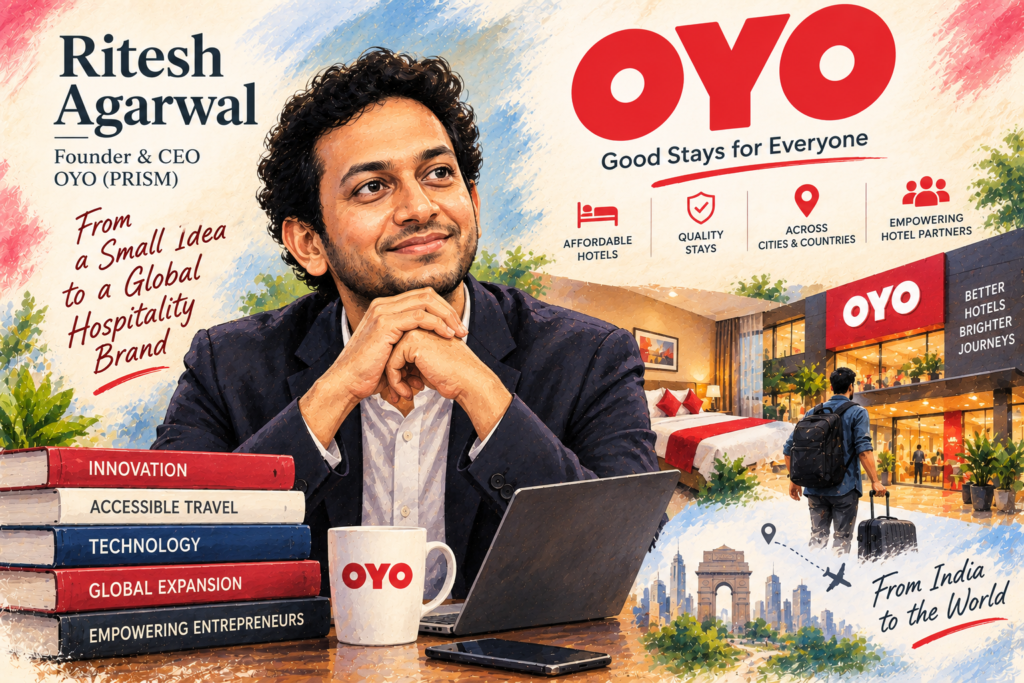
Ritesh Agarwal is one of the most recognisable entrepreneurs to emerge from India’s startup ecosystem. As the founder of OYO, he transformed a simple observation about budget accommodation into a technology-driven hospitality business with an international presence. His journey is particularly interesting because he entered the business world at a young age, identified a problem experienced by millions of travellers and built a company around making accommodation more predictable and accessible.
OYO’s story is not simply about listing hotel rooms on a mobile application. It is about attempting to organise a fragmented industry, create consistent customer experiences and help independent hotel owners attract more guests. The company has also experienced the difficulties associated with rapid expansion, operational complexity, competition and the pressure to achieve sustainable profitability. These experiences make Ritesh Agarwal’s journey a valuable case study for startup founders and business owners.
By 2026, OYO’s parent company, now known as PRISM, had expanded beyond its original budget-hotel proposition into a broader hospitality technology platform covering hotels, vacation homes and international accommodation brands. The company also moved closer to a potential public-market listing, reflecting how significantly the business had evolved from its early startup days. <a href=”https://www.weforum.org/people/ritesh-agarwal/“>The World Economic Forum’s profile of Ritesh Agarwal</a> provides an overview of this international expansion.
The Early Life of Ritesh Agarwal
Ritesh Agarwal was born in Odisha, India, and developed an interest in entrepreneurship while still young. Rather than following a conventional educational and professional route, he began exploring business opportunities and travelled across India to understand how people experienced budget accommodation.
During his travels, he stayed in small hotels, guest houses and bed-and-breakfast properties. He observed that affordable accommodation was widely available, but quality and reliability varied considerably. Travellers could find inexpensive rooms, yet they could not always be confident about cleanliness, facilities, service or whether the property would match its online description.
This experience helped him recognise a gap in the hospitality market. Large hotel chains offered standardised experiences but were often expensive for budget-conscious customers. Independent hotels were more affordable, but many lacked strong branding, effective distribution and technology to compete for online bookings.
The opportunity was to bring some of the consistency associated with organised hotel chains to the fragmented budget-hotel market. Instead of constructing hotels and investing heavily in real estate, a business could work with existing property owners, improve their customer proposition and use technology to attract travellers.
In 2013, Agarwal received support through the Thiel Fellowship, a programme that encourages selected young people to pursue entrepreneurial projects rather than follow a conventional college path. His early experience demonstrated an important principle: business ideas can emerge from observing ordinary customer problems closely. <a href=”https://www.oyorooms.com/about/“>OYO’s official website</a> describes how his travels and experiences in budget accommodation influenced the company’s founding.
From Oravel to OYO
Agarwal initially established Oravel Stays in 2012 as a platform for discovering and booking accommodation. The early concept focused on connecting travellers with affordable places to stay. However, he recognised that simply listing rooms would not fully solve the underlying problem. Customers wanted more than a booking facility; they wanted a dependable experience after arriving at the property.
This led to a change in direction. In 2013, the business evolved into OYO Rooms, with a greater emphasis on standardising accommodation and building a recognisable brand. The name OYO became associated with the promise of accessible rooms delivered through a more consistent service proposition.
The shift from Oravel to OYO illustrates the importance of refining a startup’s business model. Founders often begin with an initial idea, but customer feedback and market observation reveal what people are genuinely willing to pay for. A successful pivot does not necessarily mean abandoning the original vision. It can mean finding a more effective way to deliver the intended value.
OYO’s proposition was to work with existing hotels, help them improve selected aspects of the guest experience, and use technology and marketing to increase bookings. For customers, the brand aimed to reduce uncertainty. For hotel owners, it offered access to demand, online visibility and operational support.
Understanding OYO’s Business Model
OYO’s business model developed around the relationship between three groups: travellers, hotel owners and the platform itself. Travellers needed affordable accommodation that met reasonable expectations. Hotel owners wanted higher occupancy, better distribution and improved revenue. OYO sought to connect these needs through branding, technology, customer acquisition and hospitality services.
Under the hotel-partner model, OYO works with independently owned properties rather than owning every building in which its guests stay. Depending on the commercial arrangement, the company may earn through commissions, fees, revenue-sharing agreements or other hospitality services. The precise economics vary by market, brand and partnership structure.
The asset-light approach can help a company expand faster than a traditional hotel chain that must purchase land, construct buildings and operate every property directly. It also allows local hotel owners to contribute the real estate and much of the on-site operating infrastructure.
However, an asset-light model does not eliminate operational responsibility. Customers associate the stay with the OYO brand, even when an independent partner owns the property. Inconsistent room quality, disputes with hotel owners or poor service can therefore damage the platform’s reputation. The business must balance rapid partner expansion with quality control and commercial sustainability.
Technology is central to this model. Online booking systems, pricing tools, digital distribution, property-management technology and data analysis can help participating hotels manage demand and reach customers. A wider network can also make the platform more attractive to travellers, while greater booking volumes can make it more valuable to hotel partners. This creates the possibility of a network effect, although the benefit depends on maintaining customer trust and partner satisfaction.
How OYO Used Technology to Scale
Technology allowed OYO to coordinate a large and geographically distributed network of accommodation providers. Customers could search for rooms, compare options, make reservations and access booking information through digital channels. Hotel partners could use platform tools and support services to improve their visibility and manage parts of their business.
Digital distribution was particularly important in a market where many independent hotels historically depended on walk-in customers, telephone bookings or local travel agents. An online platform gave these businesses an opportunity to reach travellers who might never have discovered them otherwise.
Technology also made it possible to collect information about booking patterns, demand, pricing and customer preferences. In principle, this information can support better decisions about room rates, promotions and inventory availability. For example, hotels can adjust prices according to demand rather than relying entirely on fixed rates throughout the year.
Yet technology alone cannot guarantee a good hospitality experience. A booking platform may function smoothly, but a guest still expects a clean room, accurate descriptions, courteous service and reliable facilities. OYO’s experience highlights a crucial distinction between digitising a business and improving the entire customer journey. The strongest hospitality platforms must address both.
Funding, Expansion and the Pursuit of Scale
As OYO expanded, external investment helped finance its growth, technology development, brand building and entry into new markets. Institutional investors, including SoftBank and other prominent venture capital firms, supported the company’s ambition to become a major global hospitality platform.
Investment enabled OYO to move beyond a relatively narrow Indian budget-hotel proposition. The company entered international markets and explored different hospitality segments, including vacation rentals and premium accommodation. Its broader strategy was to use technology and distribution capabilities across multiple brands and geographies.
International expansion increased the potential size of the business, but it also introduced new challenges. Hospitality markets differ in customer expectations, labour costs, regulations, property economics and competitive dynamics. A business model that works in one country may require substantial adaptation elsewhere.
Rapid growth also creates pressure on management systems. Expanding the number of partner properties is not enough if service quality, hotel-owner relationships or unit economics deteriorate. The more geographically dispersed the business becomes, the more important local leadership, operating discipline and financial controls become.
OYO’s experience shows why growth and business health must be evaluated separately. A company can increase its footprint and customer reach while still facing questions about profitability, cash flow and the sustainability of its expansion strategy.
The Challenges Behind OYO’s Growth
OYO’s journey has included operational difficulties and criticism relating to its relationships with hotel partners, the consistency of customer experiences and the economics of its expansion. These issues are important because the company’s business model depends on coordination among independent property owners, customers and a central technology platform.
Hotel owners need commercial arrangements that make participation worthwhile. If expectations about commissions, payments, discounts or responsibilities are not aligned, partnerships can become strained. Customers, meanwhile, judge the brand based on the property they actually experience rather than the platform’s technology or advertising.
The company has also operated in a competitive market. Established hotel groups, online travel agencies, short-term rental platforms and local booking services compete for travellers and property owners. Price alone is not a durable advantage when competitors can offer similar rates. Customer trust, consistent service, strong distribution and profitable partner relationships are equally important.
Another challenge has been the transition from aggressive expansion towards more disciplined financial performance. Startups often prioritise market share during their early years, but eventually investors and management must examine whether each market, brand and partnership contributes to sustainable returns.
For entrepreneurs, this is one of the most significant lessons from OYO. Expansion can create visibility and bargaining power, but it can also magnify weaknesses. A business needs to understand its unit economics, monitor cash requirements and build operating systems before complexity becomes unmanageable.
From OYO to PRISM: Building a Broader Hospitality Platform
OYO’s evolution has increasingly involved a broader portfolio of accommodation businesses and technology services. Its parent company adopted the PRISM identity, reflecting an ambition that extends beyond a single hotel-booking brand.
The company has developed an international presence across hotels and vacation rentals and expanded through acquisitions. One important milestone was the acquisition of G6 Hospitality, the US-based operator associated with Motel 6 and Studio 6, in 2024. This brought established accommodation brands into the company’s broader international portfolio. The World Economic Forum’s founder profile discusses this acquisition and PRISM’s international strategy. <a href=”https://www.weforum.org/people/ritesh-agarwal/“>Read the profile here.</a>
The broader platform strategy offers several possible advantages. A portfolio of brands can serve different customer segments, from price-sensitive travellers to customers seeking more premium accommodation or holiday rentals. Shared technology and distribution infrastructure may also create efficiencies across the portfolio.
However, a larger portfolio introduces additional management requirements. Different brands need distinct positioning, and customers must be able to understand what each brand promises. Acquisitions also require integration, financial discipline and attention to local operating practices.
The strategic question is whether PRISM can combine the benefits of scale with the focus and service standards required by each part of its business. Its long-term success will depend not simply on the number of properties or brands it can bring together, but on the value it creates for customers, partners and shareholders.
OYO’s IPO Journey and the Importance of Financial Discipline
As OYO’s parent company prepared for a potential public-market listing, the business entered another important stage of its development. In June 2026, reports indicated that PRISM had filed updated draft IPO papers for a proposed fresh issue of ₹6,650 crore. The reported structure did not include an offer for sale by founder Ritesh Agarwal or SoftBank at that stage. <a href=”https://www.theweek.in/news/biz-tech/2026/06/30/prism-oyo-parent-ipo-filing-update.html“>The Week reported on the updated filing.</a>
An IPO is more than a fundraising event. It can bring greater public scrutiny of financial performance, governance, business risks and the company’s ability to deliver consistent results. Public-market investors generally examine revenue quality, margins, cash generation, debt, competitive advantages and the credibility of management’s plans.
For a hospitality technology company, investors may also examine the economics of individual properties and markets, customer acquisition costs, repeat bookings, partner retention and the financial contribution of different business segments. The challenge is to demonstrate that scale can translate into sustainable value.
The proposed issue should not be confused with a completed listing. IPO plans can change depending on regulatory review, market conditions and company decisions. Readers should consult the company’s latest official disclosures for the current status and final terms.
What Entrepreneurs Can Learn from Ritesh Agarwal
One of the most useful lessons from Agarwal’s journey is the value of solving a clearly defined customer problem. OYO’s initial insight was not that the world needed another booking application. It was that travellers needed greater predictability in budget accommodation. Understanding the problem helped the company develop a more differentiated proposition.
A second lesson is the importance of business-model innovation. Instead of owning every hotel, OYO worked with existing property owners and attempted to improve how they reached customers. This allowed it to pursue a larger network without relying exclusively on capital-intensive real estate ownership. Entrepreneurs in other industries can similarly explore partnerships, technology and shared infrastructure to serve customers more efficiently.
A third lesson is the value of iteration. The transition from Oravel to OYO demonstrates that founders should be prepared to revise their original plans when evidence suggests a better approach. A startup’s first idea is a starting point, not a guarantee of success.
A fourth lesson is that growth must be supported by operating discipline. Acquiring customers and entering new markets can be exciting, but businesses must also monitor margins, cash flow, service quality and customer retention. Growth without sound economics can create a larger and more expensive problem.
Finally, brand promises must be supported by actual delivery. In hospitality, a customer’s experience is shaped by the room, the staff, cleanliness, safety and the accuracy of the booking information. Marketing can create expectations, but operational performance determines whether customers return.
The Future of OYO and Ritesh Agarwal
OYO’s next phase will depend on how effectively PRISM combines its technology platform, accommodation brands and international operations. Its opportunities include improving the digital capabilities of hotel partners, strengthening direct customer relationships, expanding suitable vacation-rental offerings and using data to improve pricing and occupancy.
At the same time, the company must maintain reliable service standards across a diverse property network. It will need to manage competitive pressure, align incentives with property owners and demonstrate that expansion can generate sustainable financial returns.
For Ritesh Agarwal, the challenge has evolved from identifying a market gap and building a startup into leading a complex international business. The skills required at each stage are different. Early success often depends on speed, experimentation and founder-led execution. Mature businesses require stronger governance, leadership depth, financial controls and repeatable operating systems.
Conclusion: A Startup Story with Lessons Beyond Hospitality
Ritesh Agarwal’s journey from a young entrepreneur in Odisha to the founder of an international hospitality platform is an important chapter in India’s startup story. OYO emerged from a practical problem faced by travellers and attempted to solve it through branding, technology and partnerships with existing hotels.
Its growth illustrates the opportunities available when entrepreneurs organise fragmented markets and make services easier to discover and access. Its challenges also demonstrate that a compelling idea and rapid expansion are only part of building a durable business.
For aspiring founders and established business owners, the central lesson is clear: identify a genuine customer need, develop a business model that creates value for all participants, and build the operating discipline required to deliver consistently. Ultimately, the strongest companies are not defined only by how quickly they grow, but by how effectively they turn growth into lasting value.