
Introduction: The Entrepreneur Behind India’s Digital Payments Revolution
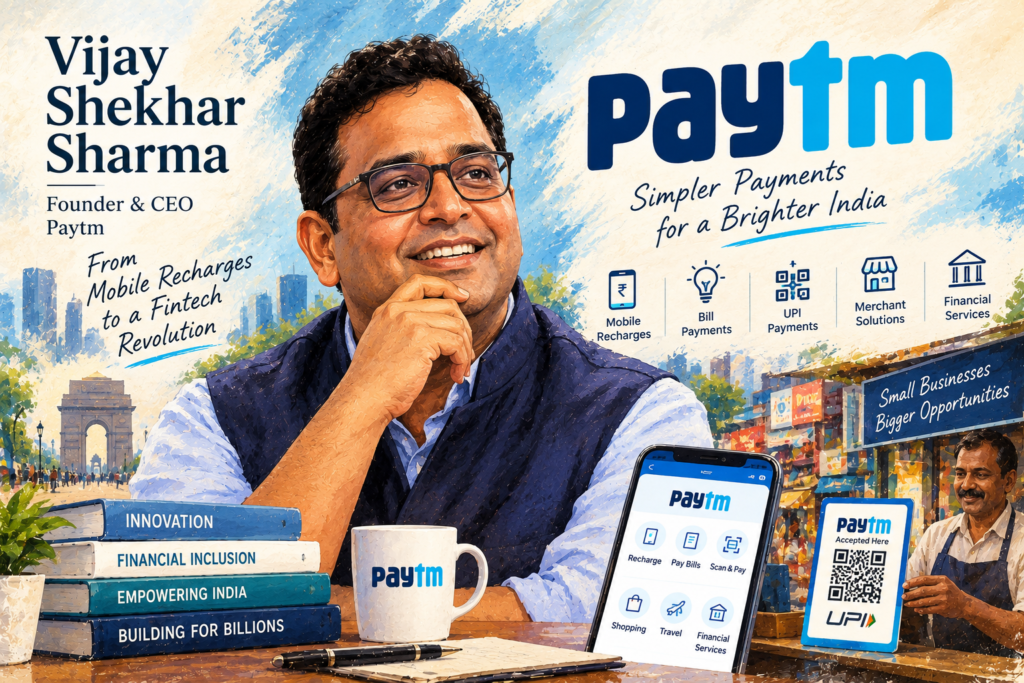
A decade ago, paying a shopkeeper, buying groceries or splitting a restaurant bill often meant carrying cash. Today, millions of Indians scan a QR code and complete transactions within seconds. The transformation of everyday payments has created opportunities for banks, technology companies, merchants and consumers. One of the entrepreneurs associated with this change is Vijay Shekhar Sharma, the founder of Paytm.
Sharma built Paytm from a digital platform initially known for mobile recharges into a broader financial technology business offering digital payments, merchant payment solutions and financial services distribution. The company’s growth reflects the increasing adoption of smartphones, affordable internet connectivity and digital transactions across India.
What makes Sharma’s journey particularly interesting is his focus on solving practical problems at scale. Paytm entered the market with a relatively simple proposition: make mobile recharges and digital transactions easier. Over time, the company expanded into new services and developed tools that helped small businesses accept digital payments.
However, Paytm’s journey has not been without challenges. Competition, regulatory scrutiny, changes in business economics and the complexities of operating financial services have tested the company. These experiences make its story valuable not only as a founder success story but also as a case study in entrepreneurship, innovation, risk management and business transformation.
Vijay Shekhar Sharma: From Small-Town India to Entrepreneurship
Vijay Shekhar Sharma was born in Aligarh, Uttar Pradesh, and developed an interest in technology at an early age. He studied engineering at the Delhi College of Engineering, now known as Delhi Technological University. His early experiences helped shape his interest in building internet-based businesses at a time when digital services were still developing in India.
In the early years of his career, Sharma explored opportunities in internet technology and entrepreneurship. In 2000, he founded One97 Communications, a company that initially focused on mobile content and related services. The business later became the corporate foundation for Paytm.
One97 Communications developed services for the emerging mobile ecosystem, including content and messaging-related products. As mobile phones became more widespread, the company gained experience in building digital services for Indian consumers. This experience proved valuable as internet access and smartphone adoption began to create new opportunities.
Sharma’s journey was not an overnight success. Building a technology business in an evolving market required experimentation, customer understanding and the ability to adapt as consumer behaviour changed. The company had to identify services that customers would use regularly and develop a commercial model capable of supporting those services.
His story demonstrates that entrepreneurship often involves several stages of learning. A founder may begin with one business opportunity, develop capabilities through that experience and eventually discover a larger market. The ability to recognise that transition can be as important as the original idea.
The Birth of Paytm: Starting With Mobile Recharges
Paytm was launched in 2010 as an online platform for mobile recharges. At the time, mobile phones were becoming increasingly important in everyday life, but recharging prepaid connections could involve visiting local retailers or using less convenient methods.
Paytm simplified this process by allowing customers to recharge their mobile phones online. Users could access the service without visiting a physical shop, creating a more convenient experience for people comfortable with internet-based transactions.
The initial proposition was focused and practical. Instead of attempting to become a complete financial services platform immediately, Paytm addressed a familiar problem experienced by a large number of consumers.
Mobile recharges also created an opportunity to develop recurring customer engagement. Customers who used the platform for recharges could return regularly, allowing the company to build familiarity with its service and introduce additional products over time.
The company subsequently expanded into services such as utility bill payments, digital wallets, ticket bookings and other transactions. Each addition created another potential reason for customers to use the platform.
This progression illustrates a useful principle for startups: begin with a clear customer need, establish a reliable service and expand when there is a logical connection between the original product and adjacent opportunities.
Demonetisation and the Rise of Digital Payments
One of the most important periods in Paytm’s growth came in November 2016, when the Indian government announced the withdrawal of specified high-value banknotes. The sudden disruption to cash availability encouraged consumers and merchants to explore digital alternatives.
Paytm was well positioned to benefit from this shift because it already had a recognisable brand and an established digital payments platform. The company expanded its visibility among consumers and small businesses by promoting cashless transactions.
For merchants, digital payments offered an alternative to cash handling. For consumers, they provided a way to make payments when access to physical currency was constrained. The wider environment accelerated the adoption of services that might otherwise have taken longer to become familiar.
However, demonetisation was not the sole reason for Paytm’s growth. The company had already invested in its platform, built customer awareness and established a pre